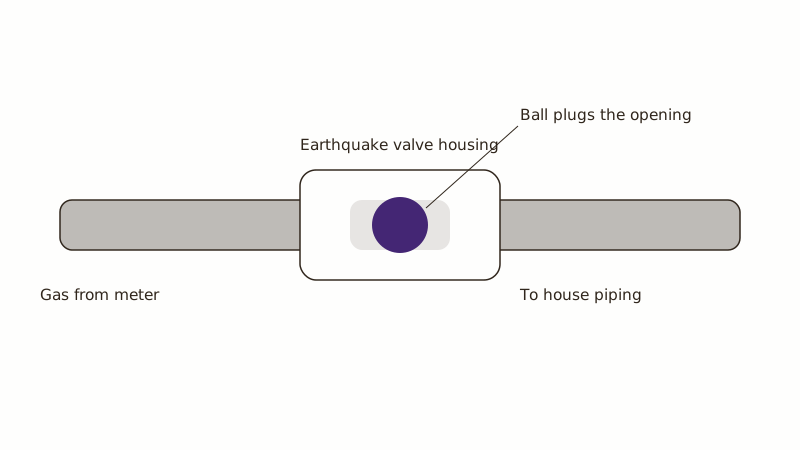
Think of the valve as a mechanical tripwire fitted to the gas piping of a house. Strong shaking drops it shut, so gas stops flowing into any pipe the quake has cracked behind a wall. Slow leaks are outside its job, and it cannot make a worn pipe sound. If you are weighing one, start at the gas line plumber overview, then read here for types, resets and the practical questions. Chaffey Pipe and Drain arranges a local plumber to price and fit one, and the written figure reaches you before work begins. Ask for that quote today.
What makes an earthquake valve close the gas?
Motion does. Strong shaking trips a small mechanical valve, typically a ball that rolls off its perch and plugs the opening, so no electricity has to survive the quake. After that the gas stays off until somebody resets the valve by hand.
Wikipedia's earthquake valve entry names two common designs. One is motion-sensing, a caged ball that falls into the orifice during shaking. The other is an excessive-flow design that closes once flow exceeds a set limit. SoCalGas puts it simply: the device cuts natural gas service when a quake of enough size strikes your home.
Who fits an earthquake valve, and where does it sit on the line?
It belongs on the pipe feeding your house, after the meter. The utility does not want it on its own equipment or in curb meter vaults, and it does not put valves in for customers, so a qualified professional does. The utility also advises asking the building department which sizes and brands it accepts.
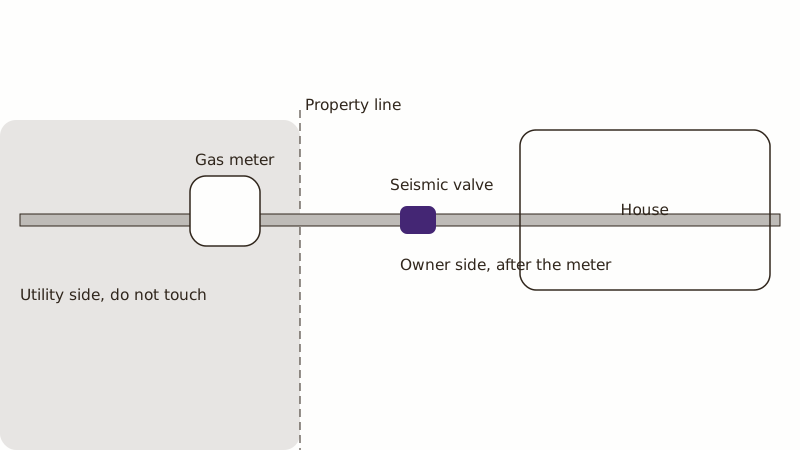
The meter valve is off limits to owners and plumbers alike. SoCalGas cites CPUC General Order 112-E for the rule that only the utility, or contractors it authorizes, operate it. A plumber therefore works downstream. Expect a permit conversation with the city, and for Ontario that is the Building counter on (909) 395-2023. Nearby cities run separate offices.
Are seismic and excess flow valves the same thing?
No. One answers to shaking, the other to a rush of gas, as when a digger severs the service line or a vehicle hits the meter. SoCalGas notes an excess flow valve will not guard against appliance faults, small punctures, quake or flood damage, and it only restricts flow rather than closing fully.
It also lives somewhere else, on the buried service pipe running from the main to the meter, and SoCalGas puts that work in the range of 2,500 to 5,000 dollars and up. A seismic valve on house piping is priced separately, and the real figure comes from a written quote by a local plumber. Whether your property already has an excess flow valve is something the utility can confirm by phone.
Can you reset the valve yourself after it trips?
The manufacturer's printed steps govern, and owners are allowed to follow them. Even so, the utility would rather a professional, or its own staff, did it, because appliances need leak checks and pilots need relighting. If you are unsure, wait for one of them.
Resetting treats nothing that caused the closure. Cracked pipes or a pulled connector make restored gas hazardous. After a major quake the utility warns that help may take days or weeks, and a valve that closed without an earthquake draws a service fee. A valve that trips without a tremor suggests a leak, a fault or a vibration source, and warrants a plumber.
What do you do at the meter right after a quake?
Usually nothing. A SoCalGas news release from 2011 advises leaving the meter on unless you catch a gas odor, hear a hiss or another clue that gas is escaping, and even then only when the meter is safe to reach. It suggests a large adjustable wrench, 12 inches or longer, near the meter for a quarter turn of the valve to horizontal.
After the meter is shut, turning it back on is not an owner job. The release says gas stays off until SoCalGas decides the house's equipment is safe, which can take days after a big event. If you suspect a leak, get away from the building, touch no switches, and call SoCalGas on its leak line, 1-800-427-2200, or 911 if danger is close.
Which earthquake gas valve is best?
Nobody can name one best model for every house, so shop for the one that fits your pipe size, meter layout and local rules. Before it goes in, confirm the model carries the approvals the city and the state expect, and ask the Building office what paperwork it wants to see.
Put these to the plumber: which line size the valve matches, where on the pipe it sits, how it resets, who backs it, and what the price leaves out, such as permit fees or the inspection. Our page on how the installation goes covers the job step by step. Your insurer may have its own rules, and SoCalGas suggests asking.
What else reduces gas risk in an earthquake?
Strap the water heater to the wall studs, and trade rigid aluminum or copper gas connectors for corrugated metal ones, which are less prone to cracking. Both come from the 2011 SoCalGas tips, and both are hardware store items. Learn where your meter sits.
A heater that topples can drag its gas line with it, so if yours is aging, see water heater repair next. Also keep heavy shelving away from exposed gas pipe. If the pipe looks old or rusty, book an inspection, because a valve cannot help a pipe that already leaks.
Common questions
Will a valve stop gas if a pipe breaks outside my house?
Usually not. A seismic valve guards the piping after it, inside your property. Damage to the buried service pipe or the meter assembly sits on the utility's side, which is what excess flow valves are for. Any gas odor outdoors goes to the utility as a report.
Can I fit the valve myself after buying one?
Hardware and supply stores sell them. The utility itself stays out of installations and tells owners to hire a qualified professional. Because gas piping work generally needs a permit, ask the Building office before anyone cuts a line, and hold off on a DIY install until you have heard back.
What if someone knocks on my door offering a SoCalGas rebate for a valve?
Verify it independently. Call SoCalGas on a number from its own website or your bill, and ask whether the offer is genuine before you sign anything or let anyone inside. A badge or a verbal claim is not proof. We did not find a SoCalGas valve rebate on its valve page, so treat the pitch with caution.
Does the valve tell me when gas is leaking at an appliance?
No. Its trigger is strong shaking, not a slow leak at a range or heater. The smell, a hissing fitting or an oddly dead patch of lawn remains your cue to call. A pressure test of the house piping by a plumber is a far better check than hoping a valve notices.
Has my valve already tripped?
Burners stop, pilots go out, and a model-specific indicator shows closed. The label or manual explains the indicator. Before a reset, check over the piping and sniff for gas, and when in doubt leave it to the utility or a plumber.