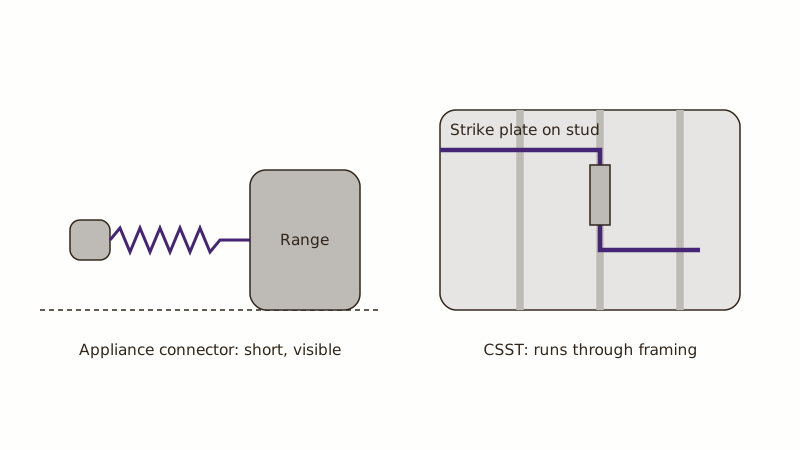
"Half-inch flexible gas line" gets used for two different things. One is the short braided or corrugated hose between an appliance and the gas valve feeding it, whether range, dryer or water heater. The other is corrugated stainless steel tubing, or CSST, which snakes through framing as part of the house piping. Rules, risks and who may install them differ. Start at the gas line plumber overview if you are comparing jobs, then use this guide for the details. To have someone size and price a run, send a quote request.
What is a flexible gas line, and which kind do you have?
If the flexible piece is short, ends at an appliance and sits in plain view, it is an appliance connector. If it runs inside walls, attics or crawl spaces and feeds several appliances, it is CSST house piping, usually yellow or black jacketed with brass fittings. Check for printed markings on the jacket, and look at where the line goes.
A connector replaces a stiff or aging link and is easier to swap. A 2011 SoCalGas release suggests trading semi-rigid aluminum or copper connectors for corrugated metal ones, because those crack less readily in an earthquake. House piping is a bigger undertaking, with sizing, bonding, supports, permit and pressure test all involved.
What does the half-inch size actually tell you?
It is a nominal size, not a promise of capacity. Carrying capacity turns on the tube's internal size, how long the run is, how many fittings and bends it has, and the system pressure. Gastite's guide has installers pick from its capacity tables or other approved ones, using the combined appliance load and the longest run.
The guide notes that downstream of the meter, most residential natural gas systems run below half a pound per square inch. That low pressure is why a long half-inch run feeding a range and a dryer may starve a tankless heater added later. Appliance input ratings come from the plate on the equipment, and a plumber should add the loads before choosing a pipe size.
Who is allowed to install CSST?
Someone with the right contractor license who has also completed the manufacturer's own training course. Gastite's guide says installers must meet the qualifications set by the local authority that enforces plumbing or mechanical codes, and must have completed the manufacturer's training program. It warns that improper installation can result in fire, explosion or asphyxiation.
California's contractor board asks for a license from $1,000 in labor and materials, and at any price once a permit is involved. Gas piping usually brings a permit. Ontario's Building counter takes questions on (909) 395-2023. Nearby cities run separate Building divisions, so ring whichever one covers your address.
What do the bonding rules say about CSST?
CSST needs protection from lightning-related arcing, and there are two ways to give it. The ICC's guide to the 2021 model code says standard yellow CSST gets an extra bonding connection to the home's grounding system, while listed arc-resistant black-jacketed CSST is protected by its jacket and does not need that extra conductor.
Per the ICC, the bonding wire is 6 AWG copper or larger, and the run to the clamp cannot exceed 75 feet. It is also about a model code. California adopts its own plumbing code, so the local Building office and inspector decide which edition and amendments apply. The work should be done by someone who can show the inspector the bond. Never assume an older installation is bonded.
Which pipes carry natural gas through a house?
Inside the house, black steel pipe with threaded fittings and CSST are the common choices, and corrugated connectors reach the appliances. Buried yard lines are often plastic with a metal riser. Local rules vary on which materials are accepted, and the building office has the final say.
The rule of thumb is to match the material to the code and the location. Our page on residential gas piping codes lists the questions to ask an inspector. A plumber should name the material in the quote, along with fittings, supports, the shutoff at each appliance and the test.
What are the rules for yard gas lines and burial depth?
A Building and Safety handout from an Inland Empire city cites 2022 California Plumbing Code section 1210.1.6. It calls for non-metallic gas pipe at least 18 inches under grade, and for metal pipe to sit six inches above finished grade or arrive factory wrapped. It adds a 14 AWG copper tracer wire, a metal riser and a factory transition fitting.
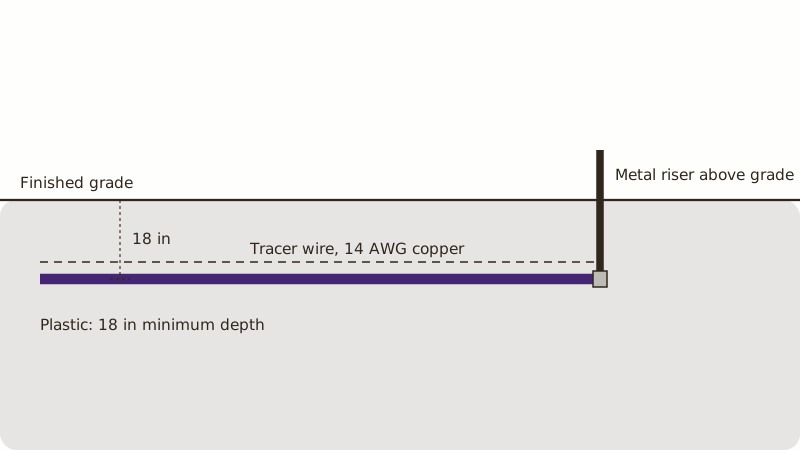
The same sheet says metal fittings must be primed and wrapped, and gas piping under covered patios must be sleeved and vented outside the structure. Your own city may differ, so ask its Building office for the current sheet. Call 811 before digging, and do not trench across a line you cannot identify.
Is it acceptable to run flexible gas line inside walls?
CSST is made for that, but it must be protected where it passes studs and plates. Gastite's guide includes strike plate protection and notes limits for certain sizes in hollow walls. The tubing must be supported, kept from sharp bends, and not run where it can be punctured by a nail or screw.
An appliance connector must not pass through a wall, floor or ceiling, and must stay visible and accessible. Makers usually state such limits in the product instructions, which are worth reading. If you are moving a range or adding a gas fireplace, the plumber should decide between rigid pipe and CSST and put the choice in the quote.
What about gas lines for mobile homes?
Manufactured homes follow their own rules and fittings, and a park or the local authority can add conditions. I cannot give you one rule that covers every case. Have the plumber confirm which standard governs your home and where the connection point is.
Some points are common sense. Underbelly piping is exposed to movement and damage, and the flexible connection between home and yard line has to be rated for it. Do not use a household appliance connector as a substitute. The local Building office is the place to start, and related checks appear under mobile home plumbing inspections.
Common questions
May an owner swap a flexible connector alone?
Many owners do, with the shutoff closed, a connector that matches the appliance and the fuel, and a leak check with soapy water afterward. It is the limit of homeowner work. New piping, caps and relocations need a contractor. Gas odor at any stage means everyone leaves, and the SoCalGas leak line, 1-800-427-2200, gets the call.
Is CSST safe?
Code accepts it when trained installers follow the maker's rules and the local code, including bonding or an arc-resistant jacket. The risk comes from poor installation. Ask the plumber about the product, the bond, strike protection and the permit and inspection.
Does a half-inch line have enough capacity for a stove and dryer?
It depends on the length, the fittings, the pressure and the loads. Gastite's method sums the appliance load, takes the longest run and reads an approved capacity table. Do not guess. A plumber can add the input ratings and tell you if the run needs a larger size.
Does the line need to be tested?
Yes. The manufacturer's guide says a CSST system must pass a pressure and leak test, and the local inspector normally witnesses it. A test is not something to skip, and a plumber should include it in the quote. Unpermitted piping can resurface during a sale.
Who restores service after the work?
The utility operates the meter, and SoCalGas says it should not be turned back on until it determines the home's equipment is safe. After a repair, the steps for testing, inspection and restoring service depend on the permit and the utility, so confirm the sequence with your contractor and the Building division. Do not relight appliances until the piping has been tested.