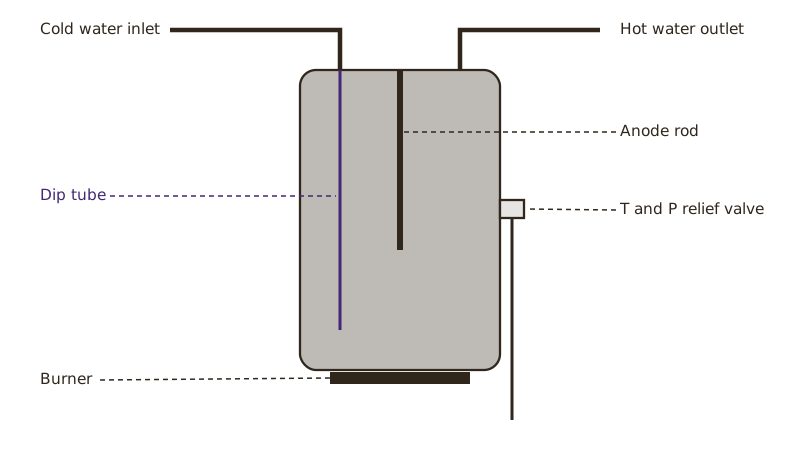
A yardstick, not an Ontario bid: Angi's July 2026 national estimates start around $600 for the cheapest electric tank and top out near $3,900 for a high-end tankless job. The table below splits that spread by type. Tank versus tankless is argued in the repair and replacement hub, and to get someone out, fill in the quote form.
| Type, installed (national guide) | Spread |
|---|---|
| Gas tank | from $700, topping out near $2,700 |
| Electric tank | from $600, topping out near $3,500 |
| Tankless | $1,400 at the low end, roughly $3,900 at the high end |
| Hybrid heat pump | from $1,200, topping out near $3,500 |
What counts as a fair price for a new water heater?
Anything inside the national bands above is plausible for a standard tank, and where you land depends on extras. In that guide, labor on a tank swap is $150 up to $450, while tankless labor starts at $600. These are guide numbers from one published summary, not Ontario rates, so use them to spot an outlier, not to bargain.
What lifts a bid: moving the heater, enlarging the gas line, new venting, a permit, removal of the old tank, and an expansion tank (often needed, though not in every house). The same source lists removal at $100 to $500, expansion tanks at $90 to $350 and permits at $25 to $300 depending on the city. Separate lines on each bid make two offers comparable. Treat the totals as a planning range; the estimate prepared by a plumber who has inspected your garage or closet is what counts.
What does flushing a tankless heater run?
Published guides vary on what a flush visit costs, and they are not local rates, so look for the exact figure on your estimate. Flushing matters because scale builds inside heat exchangers, and a heater in a hard-water area may collect it faster, so ask the plumber how often your model needs one.
Ontario's own report shows why. The city's 2025 water quality figures list hardness averaging 91 to 177 ppm, depending on which source feeds the address, and Chino's 2024 report shows city wells reaching 280. Minerals settle on the bottom of tanks and coat tankless parts, so owners here tend to plan a flush each year. What a service call includes is covered in servicing and repairing tankless units. Thinking about softening the supply instead? See softener installation pricing.
Which tank size suits my household?
The same cost guide pairs a 40-gallon tank with one to four people and a 50-gallon tank with three to five. An 80-gallon tank serves big households or heavy demand. Installed totals nationally: 40 gallons costs $800 to $2,300; 50 gallons, $800 to $2,500; and 80 gallons, a wide $1,300 to $7,500.
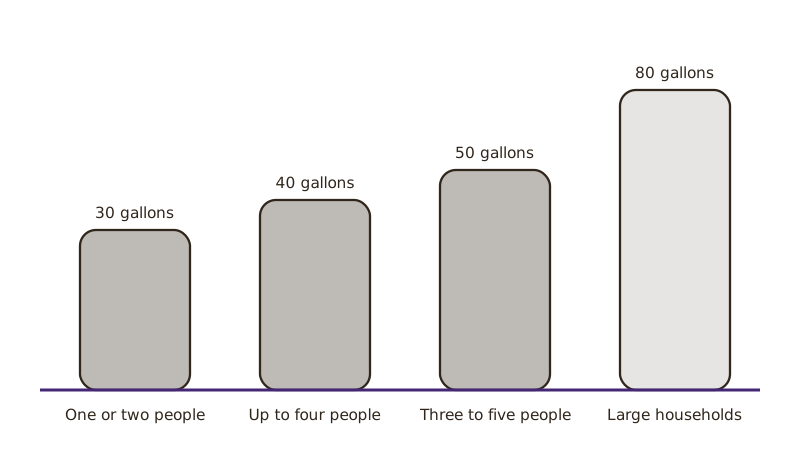
A 30-gallon tank costs less and fits one or two people. Count simultaneous use rather than residents: a pair of showers and the dishwasher can empty a small tank. For tankless, size by flow, meaning how many fixtures run together. Department of Energy figures say demand-type units beat storage tanks on efficiency by a quarter to a third (24 to 34 percent) compared with storage tanks in a household using under about 41 gallons daily. Sizing is also covered in swapping out a hot water heater.
Why do some replacements cost double others?
Because the cheap ones copy what is there: same size, same location, same fuel, with venting and gas connection already right. The costly ones change something. Going from a gas tank to tankless usually brings gas pipe upsizing and fresh venting, and an electric tankless wants a heavy dedicated circuit. Every change adds labor, parts and inspection time.
Placement matters too, because an attic closet is harder to work in than a garage corner. Earthquake strapping is required for water heaters in California, and Chino's building division posts a handout on it. Water heater replacement commonly needs a permit, so confirm with the city building division; call (909) 395-2023 for Ontario's Building office or 909-334-3251 for Chino's. Fuel choice is yours for now; nothing forces a switch away from gas. Fuel-by-fuel pricing is on separate pages: gas heater replacement, electric heater replacement and tankless installation.
Is a repair cheaper than a new heater?
Often, when the fault is a part. Electric units lose elements and thermostats, gas units lose thermocouples and pilot assemblies, and relief valves wear out. A leaking tank is different: that is replacement. A young heater with a failed part is a repair candidate; an old one with a damp base is not.
Parts have their own pages: heating element replacement, thermocouple replacement, relief valve replacement and anode rod replacement. We have not read a sourced price for individual parts, so none is shown. When a heater dies with no warning, urgent water heater repair explains how a quick request works. Leaking tank? Shut the cold supply valve above it first.
How many years will a heater last?
Storage tanks commonly run 10 to 15 years, while the Department of Energy gives more than 20 years for most tankless units. Water quality and upkeep shift those figures. Rusty-looking water, rumbling, or dampness at the base of an old unit are the usual retirement signs.
A yearly flush and anode rod inspection extend a tank's life. Owners planning to stay long term sometimes pay more for a longer-lived unit. Since old tanks tend to fail as floods rather than whimpers, many people replace by age instead of waiting for failure.
Every figure above is a national guide, so plan with it as a range and let the written estimate for your own heater decide what you pay.
Common questions
Is it an all-day job?
Swapping one tank for another usually fills a morning or most of a day, covering draining, haul-off, new connections and testing. Tankless conversions with new gas piping and venting often stretch into a second day. The estimate should state the time, and a permit inspection may follow.
What belongs in the estimate before I agree?
Look for haul-away, permit, expansion tank, vent or gas line changes and strapping, listed separately. Get the brand, size and model in writing, along with the time needed and who obtains the permit. Contractor license rules here apply to permit jobs and to anything reaching $1,000.
Must I be present?
Ideally, yes. Whoever is home shows the heater and the shutoffs at the beginning and checks the result at the end. Water will be off for part of the day, so plan showers around the work and clear a path to the heater. If the heater is behind a locked door or inside a closet, clear the path beforehand.