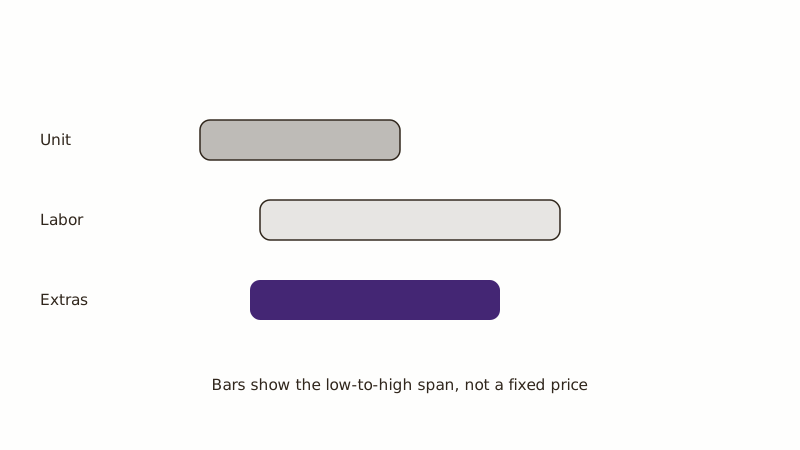
For a standard 50-gallon electric tank, one national cost guide shows $800 to $1,800 installed, with the unit at $500 to $900 and labor at $300 to $900. Smaller and larger tanks scale from there, and extras such as wiring or an expansion tank can add more. The wider topic lives under water heater repair; this page is the electric price breakdown.
How much should you expect to pay to replace an electric heater?
National figures put a complete swap between $600 for a 30-gallon tank and $2,500 for an 80-gallon one, with most homes in the $700 to $1,800 band for 40 to 50 gallons. These come from one guide's April 2026 snapshot, so your local quote may be higher or lower.
| Tank size | Unit | Labor | Installed total | Yearly running cost |
|---|---|---|---|---|
| 30 gallon | $350 to $600 | $250 to $600 | $600 to $1,200 | $280 to $340 |
| 40 gallon | $400 to $750 | $300 to $750 | $700 to $1,500 | $360 to $430 |
| 50 gallon | $500 to $900 | $300 to $900 | $800 to $1,800 | $420 to $500 |
| 65 gallon | $600 to $1,050 | $400 to $1,100 | $1,000 to $2,100 | $470 to $560 |
| 80 gallon | $700 to $1,200 | $500 to $1,300 | $1,200 to $2,500 | $550 to $640 |
One more caution: the same guide shows a different low end for 80-gallon tanks in its FAQ, so read every figure as approximate. Your real cost arrives on a local plumber's paper quote, once somebody has seen the tank, the circuit and the room around it.
Is electric cheaper than gas to replace and to run?
The swap itself is typically cheaper. According to the guide, electric labor runs $150 to $400 under a gas install, because no gas line or flue is involved. Running is the other half: resistance heating is the most expensive fuel to operate per year, which the running-cost column above reflects.
Where a house has gas available, the lifetime cost can favor a gas heater even though the swap costs more. Changing fuel means new piping, venting and permits, and gas work needs a California contractor, so it grows well beyond a straight exchange.
Because natural gas in this area comes from SoCalGas, ask the utility if a gas line is already stubbed to the water heater location. For the other fuel, read what a gas replacement costs.
Does hard water affect a replacement quote?
Possibly. Mineral scale coats elements and supply lines, which can lead a plumber to suggest flushing first; the guide shows that at $50 to $150. Ontario's utility reported average hardness of 91 to 177 ppm in 2025 depending on source, and the USGS calls 121 to 180 mg/L hard.
The USGS also says scale shortens equipment life and makes electric heaters less efficient, so prevention is worth thinking about once the new tank is in. The options sit in preventing hard water scale. A softener is one route, but local rules on self-regenerating units may apply, so check with the city building division and read softener installation cost before planning one. As always, the written quote from a local plumber is what fixes the price of any flush or add-on.
Which extras show up on electric water heater quotes?
The same guide lists several, each separate from the base price. An expansion tank is shown at $80 to $150 installed, a drain pan at $100 to $250, and a permit at $25 to $300, often folded into the plumber's price. Replacing old aluminum branch wiring with copper is listed at $200 to $600.
Less common: cloth-jacketed or knob-and-tube wiring (the guide says $500 to $1,500), a new shutoff valve where the old one is corroded ($30 to $80 in parts, plus labor), and a flush of the supply lines in hard water ($50 to $150).
Do not assume every extra applies. Ask the plumber to itemize and explain each line. An expansion tank, for instance, is frequently needed once a house's plumbing is sealed off from the street, for reasons explained in expansion tank replacement. For permits, ask the city building division; Ontario Building answers at (909) 395-2023. None of these lines is a price for your house until a local plumber has put it in a written quote.
Why does the total change from house to house?
Because the swap is not just the tank. Capacity, the age of the electrical circuit, the condition of the shutoff valves and whether code items are missing all add or remove cost. The guide expects a tidy swap to consume 1.5 to 3 labor hours; houses with surprises run longer.
What usually pushes the number up:
- A bigger tank, since cost rises with capacity.
- Old or undersized wiring. The guide notes that a 4500-watt element needs a 30-amp breaker and that older aluminum or cloth-jacketed wiring can be expensive to deal with.
- A shutoff valve so corroded it will not close.
- Missing code items such as an expansion tank or a drain pan.
- Hard access: an attic, a tight closet or a second floor.
And what pulls it down: an existing, correctly sized circuit, valves in good shape, a garage location and a same-size replacement.
How can you compare quotes for the swap?
Collect itemized quotes naming the unit's make and model, tank size, labor, permit, expansion tank, drain pan, wiring work, haul-away and warranty. Same size and same extras, or the comparison means nothing. Run each contractor's name through the state licensing board.
Each quote should carry a permit line with a name beside it. California reserves permitted work for contractor-license holders, so skipping the paperwork saves nothing and risks plenty.
To line up visits, use the quote page; the home page has the overview.
Is it worth repairing instead of replacing?
Not if the tank body leaks. A dead element, a failed thermostat or a relief valve fault on a young tank deserves repair. The Department of Energy gives tank heaters 10 to 15 years, so age tilts the choice, and a pricey fix on a tank approaching its thirteenth year is hard to justify.
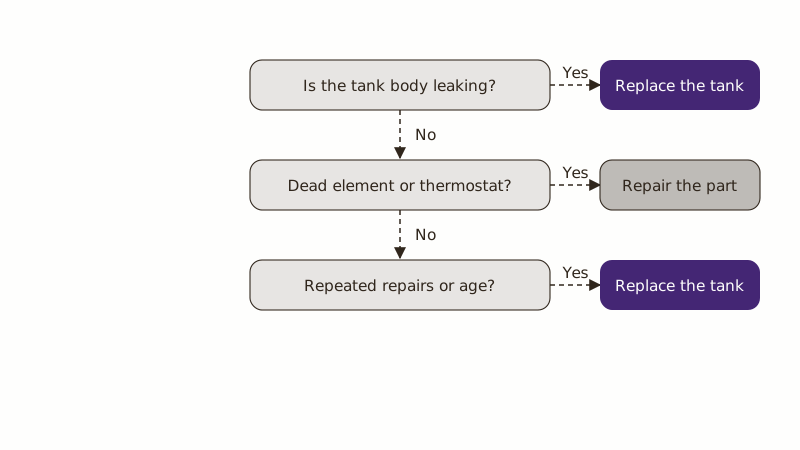
Repeated repairs are a sign the unit is finished. Start from fixing a leak to confirm where the problem sits, and see how often to replace.
Common questions
Does household size decide the tank?
Yes. A larger household draws more hot water, which calls for a larger tank, and a bigger tank costs more both to buy and to heat. The table above shows that the jump from 40 to 65 gallons adds a few hundred dollars. Ask the installer how they chose the size, and whether it matches your use.
Are heat pump water heaters priced differently?
Heat pump models use far less electricity but cost more up front. We have not read a source with Ontario prices, so none appear. Request itemized quotes, and check rebates or tax credits with the program itself, since those change often.
Can I replace the electric heater myself?
An experienced DIYer can, but this is a job where permits and wiring matter. A permit is typically needed in California, and permitted electrical work calls for a contractor license. A mistake can mean fire, scalding or flooding. Most owners are better off hiring and checking the work.
Why was my first quote so much higher than the guide?
National figures are averages across many regions and many house types, and local labor, permit and material costs differ. A quote that includes wiring upgrades, an expansion tank and a drain pan will be well above the base range. Request extras on separate lines, which shows what is optional.