Evaporate or heat hard water and calcium carbonate stays behind as scale. Nothing stops it completely except taking the hardness out upstream of the tap and the heater; everything else only slows it. The equipment side is in softener installation. What follows covers the figures, the local data and a routine.
What do ppm and grains per gallon mean for hardness?
Both count dissolved calcium and magnesium, expressed as calcium carbonate. Parts per million (ppm) and milligrams per liter (mg/L) are interchangeable here. A grain per gallon is a larger unit, and Monte Vista Water District's FAQ gives it as 17.1 mg/L, so 171 ppm comes to 10 grains per gallon.
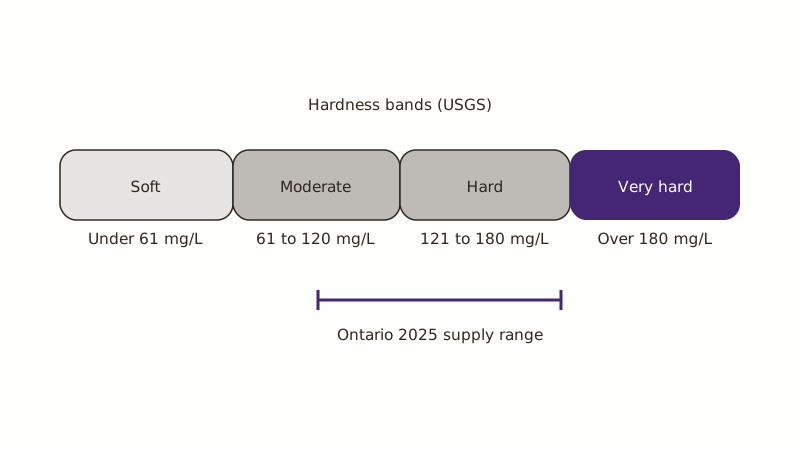
USGS draws its bands like this: under 61 mg/L counts as soft, 61 through 120 as moderately hard, 121 through 180 as hard, and past 180 as very hard. Hardness is not pH. pH tracks acidity, hardness tracks minerals, and a report can show a normal pH next to a high hardness number.
How hard is the water where I live?
Utilities publish it. Ontario's 2025 report lists hardness averaging 91 to 177 ppm by source, depending on where your block's water comes from. Chino's 2024 report shows its own wells averaging about 248 ppm, up to 280. Monte Vista's 2025 report, for Montclair, averages 135 ppm, with a high of 340. Jurupa's 2025 report averages 162.
| Supplier | Hardness reported | Grains per gallon (our arithmetic) |
|---|---|---|
| Ontario, 2025 | 91 to 177 ppm average by source | about 5 to 10 |
| Chino city wells, 2024 | 248 ppm average, up to 280 | about 14, up to 16 |
| Monte Vista, 2025 | 135 ppm average | about 8 |
| Jurupa CSD, 2025 | 162 mg/L average | about 9 |
Most of these figures fall in the USGS hard band or above. Your address may get a blend, so read the water report for your supplier.
What damage does scale cause around the house?
The USGS says deposits from heated hard water can wear a water heater out sooner and push heating bills up, and that scale built up over a long time can narrow pipes and cut pressure. On fixtures it is white crust; on glassware, film. The same source says it is no health concern, only a nuisance and an expense.
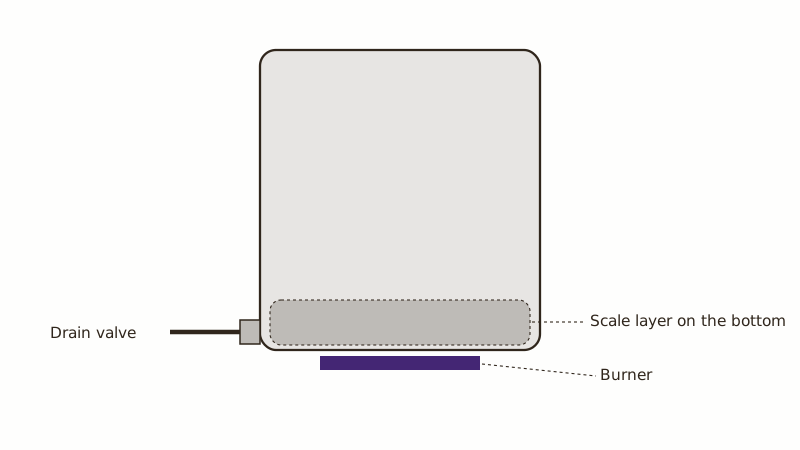
The water heater is the costly place to find it, and a tank that thumps or crackles probably sits on a layer. Clearing what is already there is covered in removing scale, and water heater repair explains what gets inspected inside the tank.
Which methods prevent scale, and which just reduce it?
Pulling minerals out with a softener that uses salt is the one method that prevents scale in every tap. Conditioners without salt, and anti-scale gadgets, leave hardness in the water; their makers say they alter how it crystallizes. A shower-head filter treats a single outlet. Magnetic and electronic units have mixed evidence, so ask to see test data first.
Cheaper habits help at the margin: wipe fixtures dry, soak shower heads and aerators in vinegar now and then, and have the heater flushed. For the whole house, only softening tackles the cause; whole-house installation shows what that involves.
Which prevention steps fit my hardness level?
Match effort to the number. Up to about 120 ppm, wiping surfaces and an occasional descale is enough. From 121 to 180 a softener begins to make sense for a household that runs the water heater daily. Past 180 ppm, treatment is worth pricing.
Local figures sit mostly in or above the hard band, so many homes here are candidates. A report gives a supplier average, but a cheap test kit used at your own tap says more. The size of unit follows from the number you measure.
How do I keep scale under control at the water heater?
A flush clears loose sediment from the tank, and the same visit can include a look at the drain valve and anode rod. Because heating drives scale formation, a lower thermostat setting reduces it somewhat. Most households do not need very hot water.
Inside a tankless unit the heat exchanger scales up, so hard water means periodic descaling, and a plumber can set the schedule. What that visit covers is described under tankless service. A softener upstream protects either kind of heater.
A fuller list of plumbing services sits on the main page of this site.
Common questions
Can I handle this myself?
Cleaning fixtures and aerators, yes. A softener needs a bypass, a drain line and an outlet, so it counts as plumbing work. Anything near a gas heater, flushing included, deserves care. A plumber can do the equipment and the first flush, then show you the routine.
How often is descaling due?
No single schedule fits. Check shower heads and aerators when flow weakens or crust appears. For a heater, have the tank looked at when it rumbles or hot water runs short. The harder the water, the more often; a softener stretches the gap.
Will a softener clear scale that is already inside pipes?
No. It prevents new scale and may slowly ease light buildup, but heavy deposits in old pipe stay put. Badly scaled galvanized pipe is usually replaced, not cleaned. Whether your pipes are narrowed shows up in a cut section or a flow test.
What do I ask a water treatment installer?
Start with the license number, the unit's capacity, the hardness it was sized for and what a service visit costs. Then ask whether salt or drain discharge rules apply where you live. Insist on the answers in writing, and weigh two quotes before committing to either.
Can I test the hardness of my own water?
Hardware stores sell test strips and drop kits that give a hardness reading in a few minutes. For a firmer number, a lab test is available. Compare the result with your supplier's report and with the USGS bands above, and bring both to any installer who quotes. Retest after a softener goes in, since the unit should bring the reading down toward the soft band.