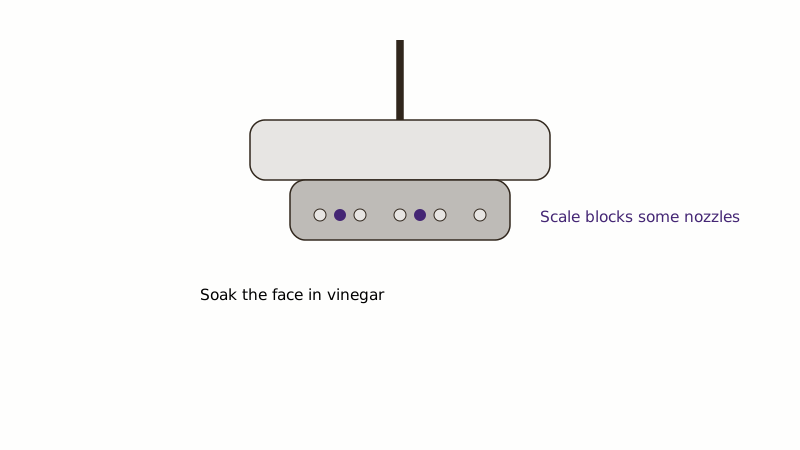
The crusty white ring on a faucet is calcium carbonate that stays behind once hard water evaporates; a gentle acid dissolves it. Light buildup on fixtures gives way to white vinegar or citric acid within about an hour. Scale far down in a heater or in the pipes is another story, and there the water softener or other treatment question arises.
What removes scale from faucets and showerheads?
An acid. White vinegar works for most chrome, glass and plastic: wrap the fixture in a vinegar-soaked cloth, or tie on a bag of vinegar, for roughly an hour at most, then scrub lightly and rinse. Citric acid solution works the same way. Stop sooner on brass, brushed or colored finishes, and read the maker's care guide first.
Removable parts are easier. Unscrew the aerator or showerhead and leave it submerged in a bowl of vinegar. Once the scale softens, clear stubborn spray holes with a pin, rinse, and refit it with fresh thread tape.
Some surfaces should never meet vinegar: natural stone such as marble or travertine, unsealed grout and some rubber seals. Vinegar can etch stone and degrade rubber. Where the surface is uncertain, test on a hidden spot or use a product made for that material.
Does scale inside a heater ever come out?
Partly. Draining a tank heater clears loose sediment, but hard crust on the elements or tank walls stays. For an electric tank, a plumber can pull and clean or replace a scaled element. The USGS notes scale in water heaters shortens equipment life and cuts efficiency in electric units.
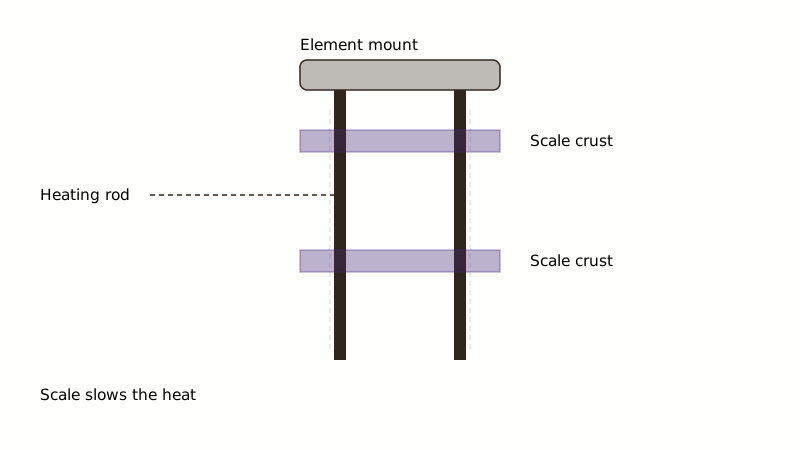
Tankless heaters are more exposed. The Department of Energy's guideline says scale builds in the copper heat exchanger and can restrict flow and shorten life, so the manufacturer specifies a flush, with the guideline mentioning intervals from twice yearly to every three years. Owners typically use a small circulation pump, a pair of hoses and a descaling liquid the maker approves.
Follow the manual for the product and the steps. Strong acids in the wrong unit can damage parts. If the heater now gives weak hot flow, see hot water pressure low, and to judge a heater's age, read replacement timing.
How hard is the water where you live?
Hard in much of the area, but the figure depends on your utility and source. Ontario's 2025 report lists average hardness from 91 to 177 ppm depending on source; Monte Vista Water District reports a 2025 average of 135 ppm for Montclair; Jurupa Community Services District, serving Eastvale, a 2025 average of 162 mg/L; Upland's 2024 report an average of about 163 ppm.
On the USGS scale, 61 to 120 mg/L counts as moderately hard, 121 to 180 as hard, and anything over 180 as very hard. Since a grain per gallon is 17.1 mg/L, Ontario's 91 to 177 range works out to roughly 5 to 10 grains by our own arithmetic. Individual sources run higher: Chino's own wells in its 2024 report reach up to 280.
Do not assume your tap matches an average. Utilities blend sources, so two streets can differ. Look up the water quality report from the utility that sends your bill, and look at the row for hardness.
At what point is scale a plumber's problem?
Once scale has moved into the plumbing itself: pressure sagging across the house, a heater that rumbles or runs cool, a tankless unit throwing error codes, or valves that will not seal. Those are inside the system, where home cleaning cannot reach, and they can be signs of deeper corrosion.
A plumber can descale or replace parts, test your pressure, and advise on whether treatment is worth it for your water. California needs a contractor license for permitted work and for jobs reaching $1,000 with materials, so ask for the license details and a written scope. Open the quote page to start; the home page explains the service.
How do you keep scale from returning?
Reducing the minerals, or managing where they land. Options include a softener, a salt-free conditioner, point-of-use filters for specific appliances, and routine descaling. A softener removes hardness minerals, a conditioner changes how they form, and results with conditioners vary by product and water. Ask any seller for evidence in writing.
Here the regional rule matters. Inland Empire Utilities Agency's ordinance prohibits new installation or replacement of self-regenerating softeners, and Chino, Chino Hills, Montclair, Ontario and Upland are among the cities on its rebate list. For a non-salt-based softener, its page says to contact a company that provides exchange tank services.
Price details sit in water softener installation cost; the work itself is in whole-house softener installation; and preventing hard water scale is a separate read.
How do you handle scale on glass, tile and a kettle?
Match the method to the surface. For shower glass and glazed tile, a vinegar and water spray left for ten minutes, then wiped, handles most film. For a kettle, simmer equal parts water and vinegar, or a spoon of citric acid in water, let it sit, then rinse until the smell is gone.
A small table keeps it straight:
| Surface | What usually works | Take care with |
|---|---|---|
| Chrome faucet, glass | Vinegar soak or spray | Brushed or colored finishes |
| Showerhead, aerator | Soak in vinegar, pin the holes | Rubber washers |
| Kettle, coffee maker | Vinegar or citric acid, then rinse well | Follow the appliance manual |
| Natural stone | Stone-safe cleaner only | Vinegar etches the surface |
| Tile grout | Mild, grout-safe cleaner | Unsealed grout |
The pattern is simple: acid for carbonate scale, gentle tools for the finish, and a good rinse every time. Scrubbing with abrasive pads is how people turn a scale problem into a scratch problem.
Common questions
Is the white film on glass harmful?
Not in any way we know of. It is calcium and magnesium minerals left behind as water evaporates, a nuisance, with no health hazard that we know of. It does clog showerheads and coat heating elements, which is why it matters for equipment. Wipe it off, and consider treatment if it keeps returning.
Is vinegar or citric acid better?
Both dissolve carbonate scale. Vinegar is cheap and everywhere, but the smell lingers and it is not for stone or some seals. Citric acid, sold as a powder, has less odor and works at a measured strength. Choose by surface and appliance guidance, and always rinse thoroughly after soaking.
Is descaling a tankless heater a homeowner job?
Some owners manage it where the manual allows, with a circulation pump, hoses and the descaler the maker names. Cut the power or gas, isolate the unit and follow the manual's order of steps. If that sounds like too much, or the gas model has complicated venting, hire a plumber.
Will a descaler or magnet device stop scale?
No independent evidence we can cite exists for those devices, so we neither endorse nor dismiss them. A softener does remove hardness minerals, but the regional rule limits new self-regenerating units. When a seller makes claims, ask for lab results and the refund terms before paying.