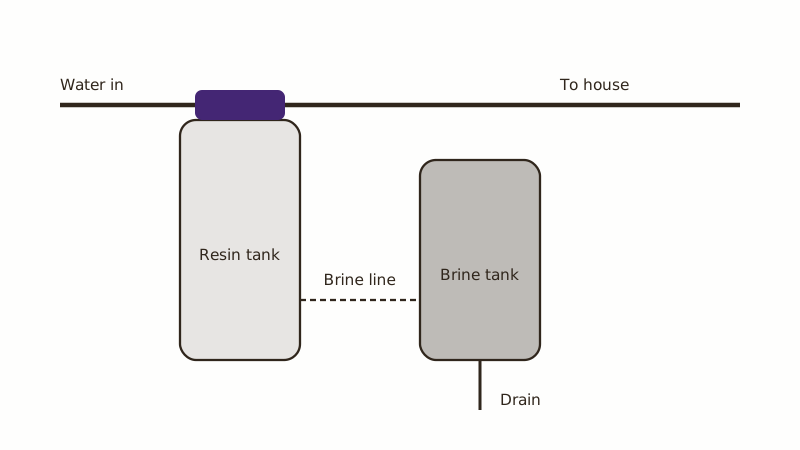
Whole-house means the unit is spliced into the incoming line, so showers, kitchen, laundry and water heater all receive softened water, while outdoor taps are usually left on hard water. It is a plumbing job with a drain connection and a power outlet. The topic is mapped on the water softeners and treatment hub, and the rule in the first section decides what you can fit.
Which kind of softener can you add in this area?
Not a new self-regenerating one, in most of the core cities. The Inland Empire Utilities Agency has an ordinance prohibiting new installation or replacement of self-regenerating water softeners. Its rebate page lists Chino, Chino Hills, Montclair, Ontario and Upland among its eligible cities. Existing units may remain, but replacing one is what the rule blocks.
What that leaves is an exchange-tank service, where a supplier swaps your tank and regenerates it elsewhere, which is the route the agency's page points to for a softener that does not harm the supply. Filters and conditioners are separate products with their own claims, and they do not take hardness out of the water the way a softener does.
Eastvale and Jurupa Valley are outside IEUA's list. Jurupa Community Services District serves Eastvale, so ask JCSD and the city what rules apply there. Whichever city you live in, check with its building division before buying, because a unit you may not install is an expensive mistake. City of Ontario Building answers at (909) 395-2023.
How is the right size worked out?
By daily water use times hardness. Multiply gallons used per day by grains of hardness per gallon to get grains to remove daily, then choose a unit that can go several days between cycles. One grain per gallon is 17.1 mg/L, a conversion Monte Vista Water District gives, so convert the ppm from your report first.
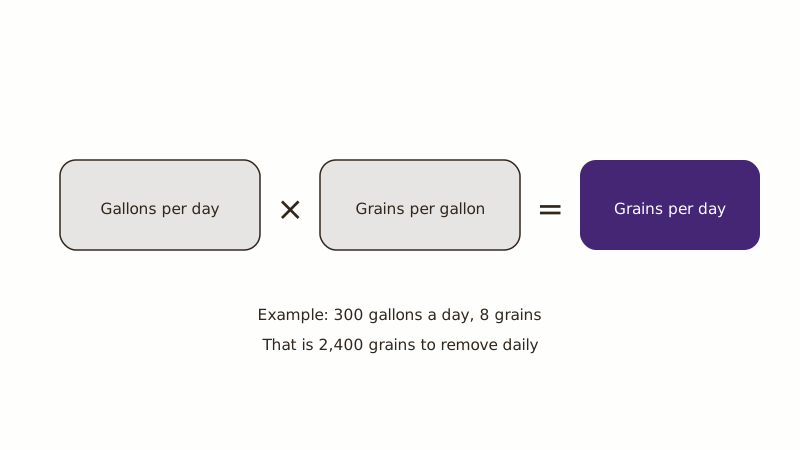
For an illustration only, 300 gallons a day at 8 grains per gallon is 2,400 grains a day. Your household will differ, and the installer should do the sum with your real numbers. Oversizing wastes money and undersizing means hard water breaks through.
By our own arithmetic, Ontario's 91 to 177 ppm range is roughly 5 to 10 grains, though sources vary and a single address may differ. Have the installer show which numbers went into their sizing.
Is there a permit, and whose work is it by law?
Possibly. Cities differ, so raise it with the building division first. In California, permitted work belongs to a contractor-license holder, as does any job that adds up to $1,000 with materials, a mark that a supply-pipe and drain installation can easily reach.
Beyond the law, a mistake here can cause a flood on the main line or a drain cross-connection. That is why most homeowners hire the plumbing and handle only the salt later. Get the license details and a scope on paper naming the unit, the connections, the drain method and any permit.
For the money side, read water softener installation cost, which gives sourced national ranges and the cost of a loop.
Where does a whole-house unit go?
Downstream of the house shutoff (and the pressure regulator, where there is one) but upstream of the water heater, in a spot that offers floor space, a drain and an outlet. Most commonly that means a garage wall, a side yard or a utility closet. A few feet of clearance around it makes salt refills and service easier.
Typical requirements:
- Access to the main supply line, with space to add valves and unions.
- A place to drain the discharge, such as the washer standpipe or a floor drain, connected so wastewater cannot siphon back.
- A grounded outlet within reach for the control head.
- Shelter from direct sun and freezing weather.
- Room for a salt bin or exchange tank swap.
Outdoor hose bibs are often split off before the unit so lawns and cars get untreated water. If your house was plumbed for a softener, there may already be a loop with valves in place, which shortens the job.
What is life like after installation?
Mostly quiet. Check the salt level monthly if your unit uses salt, keep the area clear, and test hardness now and then to confirm the unit still works. Expect softened water to feel slick on skin at first, and to need less soap, and scale to stop building up on fixtures.
Cycles use some water, and a stuck valve can waste a lot, so watch your bill. For a bill that suddenly jumps, see softeners and water bills.
Plan on occasional service: the resin, valve and seals wear. Keep the installer's details and the warranty paper in one folder.
What does the installation day look like?
A plumber shuts the main, cuts into the supply pipe, and sets up a bypass with isolation valves so the softener can be taken out of service later. They connect inlet and outlet to the unit, run the discharge line with protection against back-siphoning, power up the control head, program the hardness, add salt if applicable and run a regeneration to test.
Water service is interrupted during the work. A straightforward job is often finished within hours, but expect the plumber to name a time window once they have seen the spot. Afterward, run taps to clear air and sediment.
A good installer tests the water after the unit starts and shows you how to use the bypass. Before they leave, gather the manual, model and serial details and the warranty paper. For the same process from a homeowner's angle, try installing a water softener.
How do you decide whether you need one?
Start with the hardness figure, not the sales pitch. The water quality report from your utility lists hardness. Ontario's 2025 report shows averages of 91 to 177 ppm depending on source; Monte Vista Water District reports an average of 135 ppm in Montclair. The USGS calls 121 to 180 mg/L hard and anything above 180 very hard.
Then decide whether the effects bother you: scale on fixtures and glass, crusted showerheads, more soap needed, and scale on heater elements. The USGS says scale shortens water heater life and, in electric heaters, cuts efficiency.
Not everyone needs treatment. Where scale is only a minor annoyance, routine descaling may do, and dealing with scale directly outlines how. If you want a hardness reading at your tap, a test kit from a hardware store gives a rough number.
Common questions
Is softened water fit to drink?
Softened water is in wide use, yet the process swaps calcium and magnesium for sodium or potassium, so a person on a low-sodium diet should talk to a doctor. Many households leave one cold tap untreated for drinking, or use a separate filter. We do not give medical advice, so check with a professional about your own situation.
Can I put the softener on only the hot water?
You can, but it is unusual. Hard cold water still deposits scale in fixtures and appliances that use it, and cold-side scale on toilets and cold taps remains. Treating the whole house is the point of this installation, though some owners soften only the water heater feed. A plumber can explain which suits your goals.
Do I need a permit if I use an exchange tank?
Possibly, since the plumbing connections still change. Raise it with your building division, and learn from the exchange company what installation they provide and who performs it. Get the service contract terms in writing, including fees and what happens if you cancel.
What should I send a plumber to get a quote?
Request itemized pricing for the unit, connections, a loop if needed, the drain, an outlet and any permit. Begin at the quote page; the home page describes the service. Have your utility's hardness figure and a photo of the intended location ready.