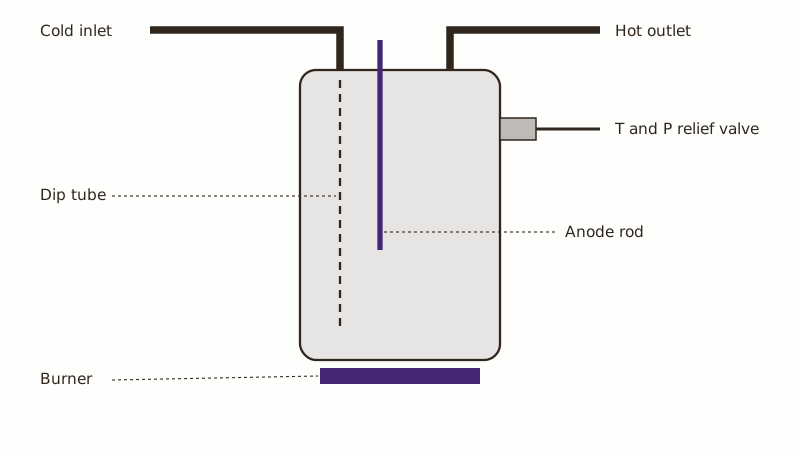
Lukewarm showers, damp concrete around the base, a tank that thumps as it heats: each points to a different failed part. Chaffey Pipe and Drain arranges a plumber for homes from Ontario to Chino and Montclair, and the first thing that plumber does is find the part, then price a fix against a swap on paper. Reach us by phone or the quote form. Everything below explains how the fix-or-swap call is made. You will find the other work we arrange on our home page.
Is a water heater a job for a plumber or for me?
Mostly a plumber's. An owner can reasonably relight a pilot per the label, or reset a breaker on an electric unit. Gas connections, flue work, burner parts, relief valves and a full tank swap sit with a tradesperson, and California ties permit work to a contractor license.
Gas explains the firmness. A badly vented gas heater pushes exhaust into the house, and a relief valve piped wrongly can scald. Suspect gas and you should be on the sidewalk when the call goes to SoCalGas, on 1-800-427-2200 (Montclair's city phone list shows the same number). Anyone feeling dizzy or sick needs 911 instead. The utility finds the leak, not you.
Which tank size suits my household?
Count the people who shower back to back on a school morning, because floor area tells you little. Gas tanks in 40 and 50 gallon sizes are common for homes, and the price gap is modest, so a busy household tends to take the bigger one. The plumber copies the figures from the old tank's data label and begins there.
Space and venting set the limits. The new tank needs its clearances in the closet or garage, and a gas unit needs a workable flue path. Tankless drops the tank but wants a bigger gas supply and its own vent. We compare the two in tank or tankless for a home here.
Which fault do plumbers see most often?
Sediment, plus a worn ignition or heating part. Hardness feeds the first. In its 2025 water report, Ontario shows average hardness from 91 up to 177 ppm, with the figure depending on which source reaches your address. The USGS adds that hard water, once heated, drops solid deposits inside a heater, which can shorten its life and push up heating costs.
You hear it as rumbling or popping, or the hot water gives out halfway through a shower. The fix is a flush, a burner or element test and a thermostat check. Water seeping from the shell itself is another matter, covered under replacement below.
How many hours does swapping a tank take?
Rarely more than a day, and often less. Same fuel, same spot is the fast version. A Sacramento plumbing firm calls standard swaps quicker than tankless installs, and a price guide puts the labor for a standard tank at two to four hours. Moving the heater, changing the vent or extending gas pipe stretches that.
Expect this order: water off, old tank drained and carried out, new tank in place, pipes and vent reconnected, fill, test. Hot water returns as the tank warms. Where a permit applies, an inspection follows; the Ontario Building counter answers questions at (909) 395-2023.
How old is my heater, and when is it finished?
No lifespan figure fits every tank, because water quality, flushing and installation all move it. Read the serial number instead: makers usually encode the build date, and a plumber decodes it in seconds. A shell that leaks marks the end of that tank. Nobody can patch it.
A weeping fitting, valve or connector is different and can be repaired, so have someone look before buying. Our notes on when to replace list further signs: rust-tinted water, damp at the base, a string of earlier repairs, a creeping gas bill.
Which problems get a repair, and which get a new tank?
A failed part gets a repair, since parts are cheap next to a tank: thermostat, thermocouple on an older gas unit, gas control, relief valve, electric element. A corroded or leaking shell gets a new tank, and so does an elderly unit with several faults at once.
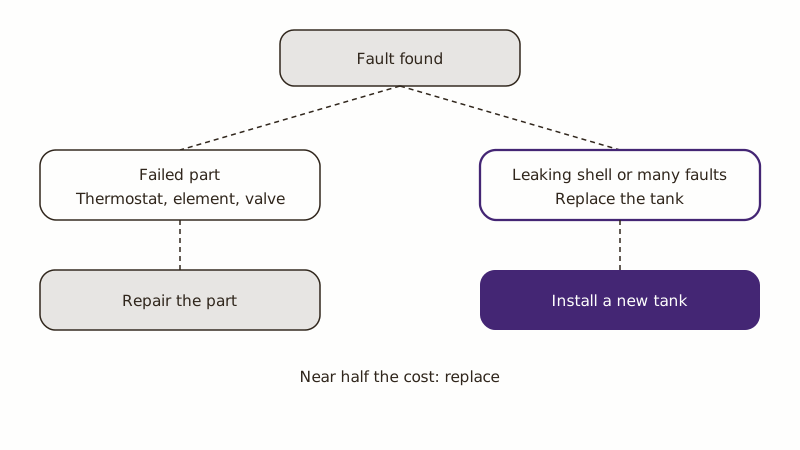
Separate write-ups cover the pilot and burner, thermocouples, relief valves, anode rods and expansion tanks. If a repair quote lands near half a new heater, a new heater is the likelier call.
What will replacement cost, and what should the quote itemize?
One Sacramento plumber's page gives installed gas swaps at $1,200 to $2,000 for 40 gallons and $1,400 to $2,500 for 50. A second guide shows a permit fee of $75 to $200 and an expansion tank at $100 to $350 installed. Both are from outside Ontario, a rough yardstick and nothing more.
Have the quote split out the heater, labor, permit, vent or gas changes, expansion tank and hauling off the old unit. The gas replacement cost guide and the all-fuel cost page walk through each line. Whatever any guide says, your price is the number a local plumber writes down after looking at your heater.
What do I check before saying yes?
Before agreeing, collect the quoting person's license number and search it on the CSLB website. State law starts requiring a license at $1,000 for labor plus materials; under that figure, a permit alone also triggers it. Past $500 you are owed a written contract. Also ask whether the permit fee sits inside the price, and who deals with a failed inspection.
California limits home improvement deposits on this kind of work. Anyone asking for most of the price before starting is a red flag. We pick up weekdays between nine and five. Requests through the quote page are accepted overnight too.
Common questions
Can a hot water heater be fixed, or must it go?
When a part is at fault, it can usually be fixed: thermostat, element, burner assembly, gas control or relief valve. When the shell of the tank leaks, there is no repair. The first visit settles most cases, since the plumber traces the water to its source, tests the controls and reads the age off the plate.
Why do some plumbers push back on tankless units?
Not all do. The objections are practical: a larger gas line, proper venting, a higher install price and descaling in hard water. In a house already plumbed for one, tankless works well. Our tank versus tankless page explains which homes suit which.
What does a tankless flush cost?
The pages we read had no flush price worth repeating, so none appears here. Ask for a flat figure per visit and ask what the plumber uses to descale. The tankless repair page covers why flushing matters where water is hard.
Is it wise to flush a ten-year-old tank?
Ask a plumber first. A decade of sediment can break loose in a flush and jam the drain valve, and an old drain valve that has sat shut for years sometimes drips for good once opened. A plumber can test the valve, flush gently and say frankly whether the tank has life left.
Can I drain the tank myself?
Yes, if the drain valve works. Move the gas control to off or cut the power, then let the tank cool before you run a hose to somewhere that can take hot water. Risks are scalding, a valve stuck open and a gas heater left off. If any step feels shaky, hand it to a plumber at another visit.