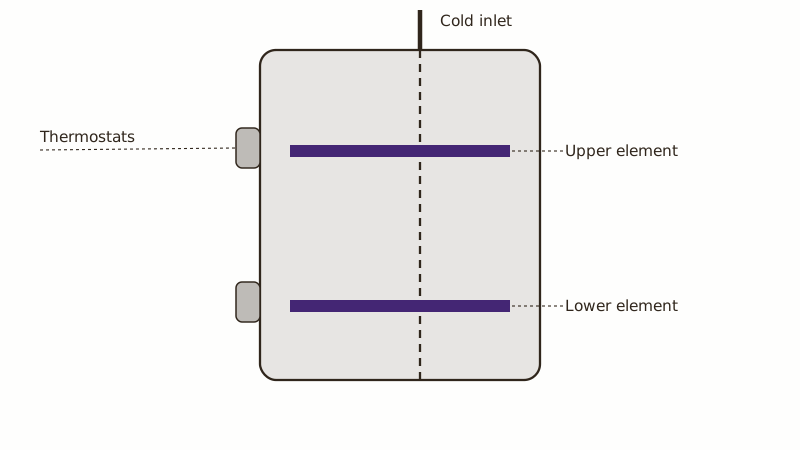
A burnt heating element ranks among the cheapest electric water heater repairs, and it is often why a tank that behaved last month now delivers lukewarm showers. Most electric tanks carry a pair, top and bottom. When either quits, hot water thins out or vanishes. The part costs little; the effort lies in proving it is to blame and handling the job safely. Related context lives under water heater repair.
Could a dead element explain why my electric tank barely heats?
Possibly. Two immersion rods sit inside an electric tank, top and bottom, and each takes orders from a separate thermostat. If the top rod dies you may get nothing hot at all; if the bottom rod dies you get a small supply that cools off fast. A bad thermostat, a tripped breaker or a tripped reset button can look identical, so test before you buy.
Gas-fired heaters have no elements, so skip this page if yours burns natural gas. The data label on the side lists voltage and often the element wattage.
Sort your symptom against likely causes.
| Symptom | Probable cause |
|---|---|
| Cold water from every hot tap | Breaker, upper thermostat, high-limit button or upper element |
| Warm but not hot water | Lower element or thermostat |
| Hot water runs out fast | Lower element failed, or sediment buildup |
| Breaker trips repeatedly | Shorted element or wiring fault |
| Rumbling or popping noises | Scale on elements, a sign of sediment |
| Water too hot | Thermostat stuck, not the element |
What kills heating elements around Ontario?
Age and minerals do most of the damage. Ontario's 2025 water report shows hardness averaging 91 to 177 ppm depending on source, and scale cooks onto the metal and piles up on the tank floor. An element buried in sediment overheats and burns out, and the sediment also makes the tank rumble and waste energy.
Dry firing is another killer: power reaching an element with no water around it. That is why order matters in the next section. Corrosion can also eat through the sheath over time, and an original element in a tank many years old may simply be spent.
Age changes the math. Federal Energy Saver guidance gives an ordinary storage tank a life of roughly ten to fifteen years, so a twelve-year-old unit with a failing element and a rusty drain valve may not deserve the part, while a younger one usually does.
How is an element tested and swapped out?
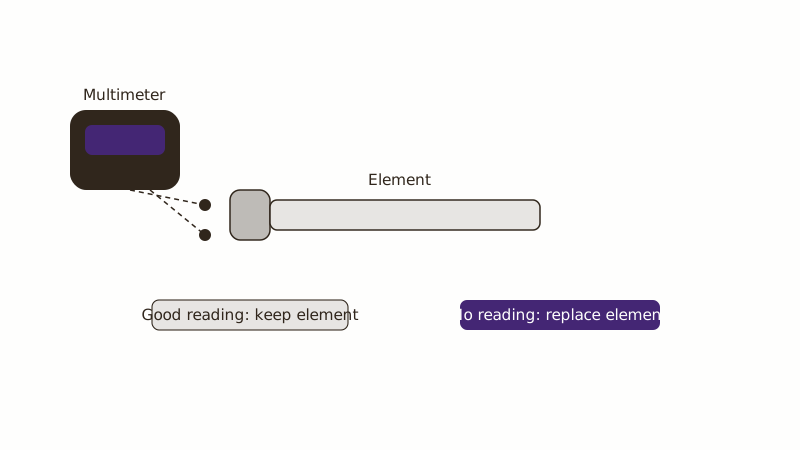
Start by killing the breaker and then testing the wires with a voltage tester to be sure they are dead. Pull the access panel and insulation, check the element for continuity, close the cold supply, drain below the element, unscrew it, fit a new gasket and element, refill the tank completely, then and only then bring power back.
Follow this sequence without skipping ahead.
- Flip the heater's breaker off, then verify with a tester that the wires carry no power.
- Remove the cover, fold back the insulation and photograph the wiring.
- Detach the leads and read the element with a multimeter; a dead reading means a dead element.
- Shut the cold inlet and crack open a hot faucet. Hose the drain valve outdoors and empty the tank until the level drops below the element.
- Unscrew the old element, scrape the gasket seat and note the wattage and style.
- Thread in the matching element with a new gasket, hand tight first and then snug.
- Reattach the wires, close the drain, reopen the cold inlet and leave that hot tap running until the stream is steady and free of air.
- Check for drips at the new element. Power comes back last.
Water first, power second, always.
Buy a twin of the old element:
What will the job run?
The element itself is typically inexpensive, and a plumber's visit adds labor. No official source publishes Ontario prices for this job, so this page quotes no number. Request a written figure covering the element, gasket, labor and any thermostat that tests bad.
Weigh that against a new heater before deciding. Replacement ranges are on electric water heater replacement pricing, and more diagnosis sits in diagnosing an electric heater without hot water.
Contractor licensing in California kicks in with jobs of $1,000 or more, a level an element swap normally stays under. The money line is not a safety line, since the job still mixes 240 volt power with water.
What else deserves a look while the panel is off?
While the panel is off, inspect the thermostats, the high-limit reset button, the anode rod and the temperature setting. A spent anode rod is a common reason tanks rust through, and flushing while the element is out clears sediment. Energy Saver advice is to keep the thermostat near 120 F.
A tank that drains slowly or a drain valve that clogs with grit points at scale. Ask whether an annual flush or a scale filter suits your supply. Related jobs include replacing an anode rod and relief valve replacement for a valve that drips.
Failing parts can hit the bill too: a tank caked in scale works harder for less hot water. High electric bills and a broken water heater explains the link.
At what stage should a plumber be called?
Choose a plumber if 240 volt power makes you uneasy, the tank leaks, the element will not budge, wiring looks scorched or the breaker keeps tripping after a new element. Water and electricity together carry real risk, and one slip can mean a shock or a ruined tank.
Gas smell near a gas-fired heater? Outside first. For a suspected leak the SoCalGas number is 1-800-427-2200, dialed from outdoors, and 911 is for anyone hurt. A gas heater is not an element job at all.
A tank that seeps from its body, rather than at the element gasket, needs replacing, not repair. Ontario's Building counter, (909) 395-2023, can say what its rules require for a water heater replacement. The quote page at Chaffey Pipe and Drain is where a visit starts; someone local comes out and quotes in writing.
Common questions
Roughly how long until the shower is warm again?
Budget about two hours of hands-on time, plus draining and refilling. The tank takes a while to empty, and it must be completely full before power returns. A seized element, rusted fitting or bad thermostat extends the job, which a plumber can flag upfront and put in the quote.
Should both elements be changed together?
Often, yes, especially on an older tank. If one element failed from age or scale, its partner is probably close behind, and parts cost little next to a second visit. You also drain the tank only once for both, which saves an hour.
Is draining the tank optional?
Not safely. The lower element sits below the waterline, so pulling it with water inside makes a mess. Drain below the element first. The upper one needs less draining, but the power stays off and the water level must be under the opening.
Which element rating should I buy?
Read the voltage and wattage stamped on the old element or the heater's rating plate. Residential electric tanks commonly use 240 volt elements, though wattage varies by model. A wrong rating can overheat the tank or trip the breaker, so bring the old part when buying.
Is an old tank worth the repair?
It depends on condition. A leaking tank, heavy rust or an age beyond the 10 to 15 years federal guidance cites points toward replacement. A younger tank with a failed element is normally a good repair candidate, because the part is cheap relative to a new tank.