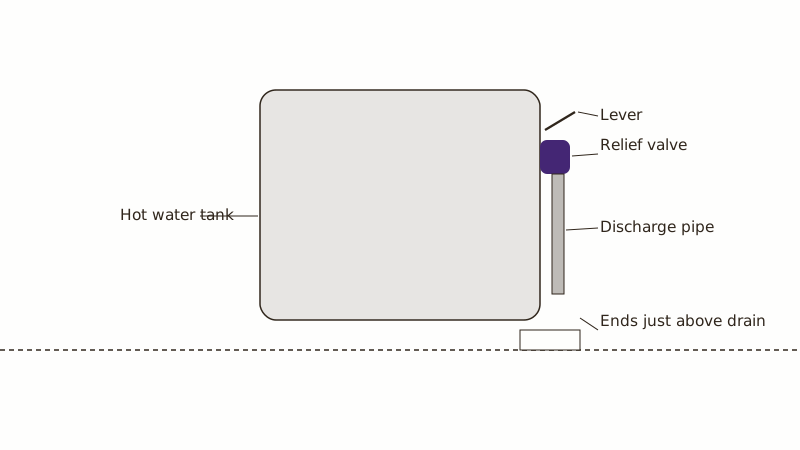
On a tank heater, a stubby brass valve fitted with a small lever, and a pipe heading toward the floor is the relief valve, usually high on the tank or its side. Its single job is to open before heat or pressure becomes dangerous. When it fails, it either leaks constantly, or worse, sticks shut. A valve that drips, spits or will not reseat after a test should be replaced, and the job belongs with a plumber for most households. This guide supports our water heater repair page and covers what to look for, what the replacement has to meet, and what the discharge pipe is for. Want a plumber to look? Fill in the quote form with the heater's age and the valve's symptoms.
How do you know the relief valve needs replacing?
Three signs: the valve drips or runs after you have tested it, the lever will not return to its seat, or you find mineral crust and rust around the outlet. A. O. Smith's manual says that if the valve fails to completely reset after a manual test and keeps releasing water, you should close the cold inlet and replace it.
A weeping valve is not always a bad valve. The same manual says periodic weeping or discharge may come from thermal expansion, which happens in a closed system, for example when there is a check valve or a meter with a check valve in the supply line. Do not plug or remove the valve. Test it, then decide.
How do you lift the lever without getting scalded?
The manual calls for operating it by hand at least once a year. Stand clear of the discharge outlet, because the water may be extremely hot, and make sure nothing will be damaged by the discharge. Lift the lever briefly, let it snap back, and watch whether it reseats fully.
Not sure where the water will end up, or no discharge pipe at all? Skip the test and phone a plumber. Scalding water can shoot out. The A.O. Smith help page also warns against touching the valve while the heater is running. Children and pets should be elsewhere, and if you suspect the valve is stuck, a plumber should handle it. A tank that is already leaking is a different case, handled under emergency water heater repair.
What must a replacement relief valve meet?
According to the A.O. Smith manual, a replacement must meet local codes and be, at minimum, a combination temperature and pressure relief valve that meets ANSI Z21.22 and CSA 4.4. Its maximum set pressure may not exceed the tank's marked working pressure, which is 150 psi on that model.
The discharge capacity must be at least the heater's input rate, shown on the rating plate. For electric heaters that is watts multiplied by 3.412 to get BTU per hour. The valve must screw directly into the fitting made for it, with no valve between it and the tank. This is why matching the old valve by thread size alone is a poor idea. Bring the rating plate figures to the store, or let the plumber do it.
What should the discharge pipe look like?
The manufacturer's rules read like a checklist. According to the manual, the pipe cannot shrink below the valve outlet size, and reducing couplings are out. It is never plugged. It uses a material listed for hot water, slopes so that valve and pipe empty completely, and finishes at a proper drain. No shutoff valve may sit in it or between valve and tank.
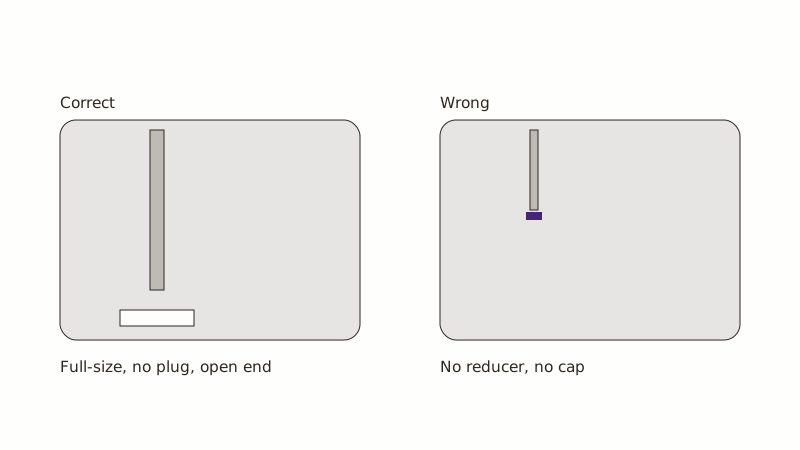
The same manual says the discharge should end within 6 inches above a drain or outside the building, and that a direct connection to a drain needs a 6 inch air gap. Excessive length, over 30 feet, or more than four elbows can restrict discharge. Local code may add rules, so the Building office is the final word. In Ontario, call (909) 395-2023 for the counter.
Should an owner swap the valve?
Many manuals describe the part swap, and some owners do it. Still, it involves shutting off power or gas, cooling the tank, draining below the valve, sealing threads and re-testing under pressure. A mistake can mean a leak or, at worst, a valve that does not protect the tank.
Gas heaters add a risk, because a disturbed gas line or a bad vent can cause a hazard. If you smell gas, shut the gas supply and get out, then phone the utility's leak line, 1-800-427-2200, and use 911 if someone is hurt or at risk. A plumber normally finishes it in one visit, and a written quote beforehand spells out what that visit covers. The article on replacing an expansion tank is a related job that often comes up at the same time.
Why does the relief valve keep dripping after replacement?
If a brand-new valve drips, the cause is generally upstream: pressure running too high, or a closed system leaving expanding water no escape. The A.O. Smith troubleshooting chart gives two reasons for a valve that drips: too much water pressure, or a closed system.
Fixes include a pressure reducing valve, an expansion tank, or both. A plumber will usually start by reading static pressure on a gauge. The manual advises a pressure reducing valve and a pressure relief valve for excessive pressure, and refers to thermal expansion for closed systems. See replacing a pressure regulator if the regulator is old. Replacing the relief valve over and over without fixing the cause only repeats the drip.
Is it worth fitting a new valve on an old heater?
No fixed number applies, because mineral buildup and test frequency differ. Valves that are never tested can stick, and valves that are tested often can fail to reseat from debris. On an aging heater, a new valve may only postpone an inevitable tank replacement.
Ask the plumber about the tank's age, the anode rod and rust at the base. Compare the cost to repair with the cost to replace. What a full replacement involves, and when it comes due, is in water heater replacement timing. Strapping the tank to wall studs is a separate quake precaution, which a 2011 SoCalGas release recommends in two places on the tank.
Common questions
Is it normal for a relief valve to drip a little?
Not normally, but it can come from thermal expansion when the system is closed. A.O. Smith's manual says periodic weeping may be due to expansion, and tells owners not to plug or remove the valve. A steady drip means pressure, a worn seat or a bad valve, so have a plumber check.
Can I cap the discharge pipe to stop the dripping?
No. The manufacturer says the discharge pipe must not be plugged or blocked, because the valve has to be free to release water and prevent injury or damage. Capping it hides the symptom and removes the protection. Fix the cause of the drip instead.
Where does the discharge pipe finish?
Within 6 inches above an adequate drain, or outside the building, per the A.O. Smith manual for that model, with no threaded or blocked end. Local code can add detail, so run any change of routing past the city's Building office first. Never run it into a closed container.
How frequently does the valve need testing?
Yearly at minimum, according to the manufacturer. Stand clear of the outlet, and expect hot water. If it will not reseat and water keeps coming, shut the heater's cold inlet and replace the valve. Not sure? That is what a plumber is for.
Does a new valve need a permit?
That varies by city and by the size of the job. A like-for-like valve swap may not, but a heater replacement often does. Ask the Building office that covers your address. Ontario's counter is on (909) 395-2023, and nearby cities have separate offices, so confirm first.