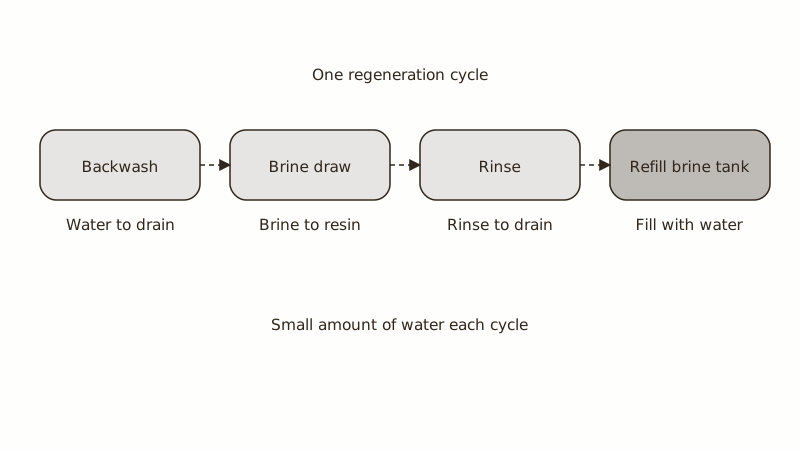
Only occasionally, and normally because something has failed. An automatic softener cleans itself with a burst of water, the regeneration cycle, and that adds a small amount to each month's use. The expensive case is a valve that jams mid-cycle and sends water down the drain nonstop. See the softener and water treatment hub for the bigger picture; this page is the bill-shock check.
Does a healthy softener add to the water bill?
A little. During regeneration the unit rinses its resin bed and pushes brine to the drain, and that water passes through your meter. Over a month it is a small slice of household use, and it arrives in brief spurts, usually well after midnight. A sharp jump in your bill is rarely down to this.
Think of it as a built-in routine cost, like a dishwasher cycle. The more hard water you have and the more people in the house, the more often the unit cleans. Capacity settings matter too: a unit set to regenerate every night on a schedule uses more than one that waits until the resin is spent.
For the actual gallons per cycle, look in the manual or on the maker's spec sheet. It varies by model, and we will not guess a number for your unit.
How do you tell if the softener is the culprit?
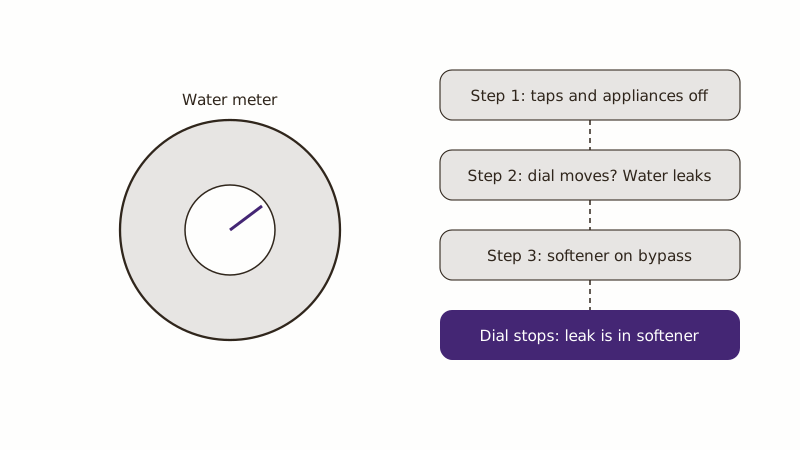
Try this meter check. With the house idle (taps closed, washer and dishwasher finished), watch the meter's small low-flow dial. A moving dial says water is escaping. Next, put the softener on bypass or close its inlet, and watch again. A dial that now sits still puts the leak inside the softener.
You can add a second clue: listen near the unit. A steady trickle or hiss from the drain hose at a time when nothing should be happening is the sign of a jammed valve. Check the drain line too, since many softeners drain into the washer's standpipe or a floor drain, and a constant stream there is easy to overlook.
If you cannot do the meter test, ask a plumber to. Leaks of this kind waste plenty over a year. The EPA's household-leak figure is more than 9,300 gallons a year, and a softener stuck on drain could match that within weeks.
Which faults make a softener use too much water?
Four faults dominate: a control valve worn or jammed open, a timer that forces repeat cycles, a seal weeping at the valve head or tank, and a brine line fault. In each case water leaves the system when it should not. Power cuts can also scramble a clock so cycles run in the daytime.
What you may see on the unit:
- The display flashing, or showing the wrong time after a power outage.
- A cycle that never seems to end, with water running at the drain.
- Dampness or white salt crust around the valve head and fittings.
- Water that suddenly turns hard again, because the resin is not being recharged correctly.
Few of these are for the owner to open up. The controller can be reset using the manual, but valve and seal repairs are plumbing work, and gas or permit work is a different matter altogether and belongs to a contractor.
Could the bill be rising for some other reason?
Very often yes. A running toilet, a dripping hose bibb, a leaking irrigation line or a broken pipe will all swell the bill, and so will new habits such as a long watering schedule. Check the usual suspects before blaming the softener, particularly if you added no new equipment.
A toilet quietly refilling itself wastes more than most people expect. Add dye to the tank, wait, and if color appears in the bowl unflushed, the flapper is leaking. The full checklist lives in why water bills run high, with a companion on a high bill but no visible leak.
Look at the billing period too: a heat wave or a month of houseguests shows up on the bill even when nothing is broken.
Is hard water a reason to keep the softener running?
It depends on your goals. The USGS says hardness above 120 mg/L is classified as hard, and that scale in water heaters shortens equipment life and raises heating costs. Ontario's water utility reports average hardness of 91 to 177 ppm depending on source, so many homes are in the zone where scale is a nuisance.
A softener addresses that, but it costs salt, water and attention. Some homeowners decide the scale is tolerable, or that a filter or descaler suits them. If your bill is high and the unit is old, a service check is cheaper than guessing.
Anyone aiming to tackle scale without a softener can start with removing hard water scale.
Can you replace an old self-regenerating softener in Ontario?
Not freely. Inland Empire Utilities Agency's regional ordinance prohibits new installation or replacement of self-regenerating water softeners, and Chino, Chino Hills, Montclair, Ontario and Upland are among the cities its rebate program covers. The rule targets new installation and replacement, so ask IEUA what applies to a unit already in your home.
So a failing unit raises a real question: repair the old one, or remove it. IEUA offers a rebate of $300 to $2,000 for a connected, working softener, plus a plumber reimbursement of up to $250, and its page lists the conditions. That money applies to removal, not to a new self-regenerating unit.
Before spending on repairs, call IEUA at 909-993-1550 or the building department, and ask about your address. The full cost picture is in softener installation cost.
Common questions
What does a single cleaning cycle use in gallons?
It depends on the model, the salt setting and the resin volume, so the manual or spec sheet is the reliable source. We cannot give a trustworthy single figure. Ask the installer to read the cycle settings with you, and write down the number of cycles per week in case you need to compare later.
Does using the bypass fix it?
Bypassing sends water around the softener, so the unit stops using any, but nothing gets repaired. Use it to prove the softener is the source during the meter test and to protect the house while waiting for service. Water then arrives unsoftened, which is fine for a short time.
Does softened water make my bill higher through extra use?
No evidence supports that. Softened water behaves the same at the tap; people may feel they need less soap or shorter rinses. The only added water is the regeneration cycle and any fault. If your bill rose without a change in the household, test for a leak before assuming the unit.
Is a hissing softener worth a phone call?
Yes, when the hiss never stops, since that means water is draining. Move the bypass, close the softener's inlet if you can, and have a plumber examine the valve. Electrical wiring and gas piping call for a contractor, so leave those alone. You can begin at the quote page or from the home page.