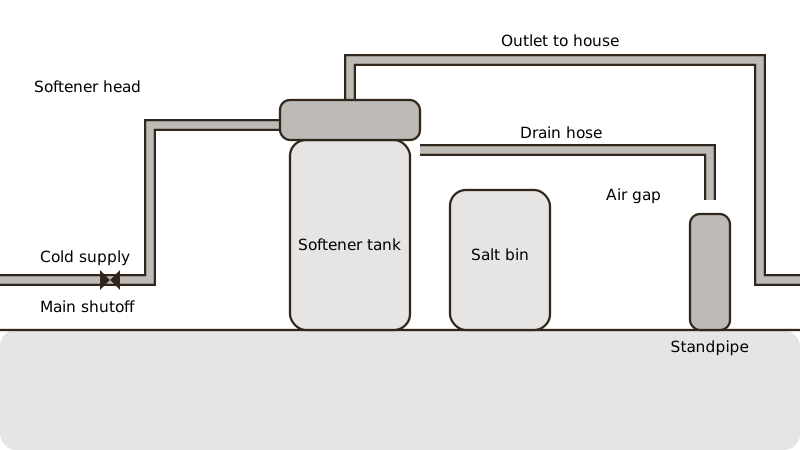
Fitting a softener on your own works when you're comfortable cutting into the cold main and running a drain hose. It fails on small oversights: no air gap, a forgotten bypass, a tank that's too small for the household. If you'd rather hire it out, softener installation with a plumber covers that. Here you'll get the do-it-yourself route, plus the moments we'd step aside.
Can an ordinary homeowner fit a softener without help?
Many can. The unit comes as a tank, a control head and a salt bin, and only two lines touch your plumbing: the incoming cold supply and a drain. Replaced a hose bib or a heater connector before? You have the skills. Never opened a live pipe? A slip inside a wall costs far more than the unit.
Walk the house before ordering. Find where the main enters. Measure the floor beside it, since the tank is roughly the size of a small trash can and the salt bin needs space too. Spot the nearest laundry standpipe or floor drain, and a grounded outlet. Two missing items usually mean extra plumbing.
Rules come next. Under CSLB rules, a contractor license enters the picture once labor plus parts reaches $1,000, and wherever a permit is needed. Phone Ontario's Building office, (909) 395-2023, to ask whether your connection needs one before you cut anything.
Does Ontario water need softening at all?
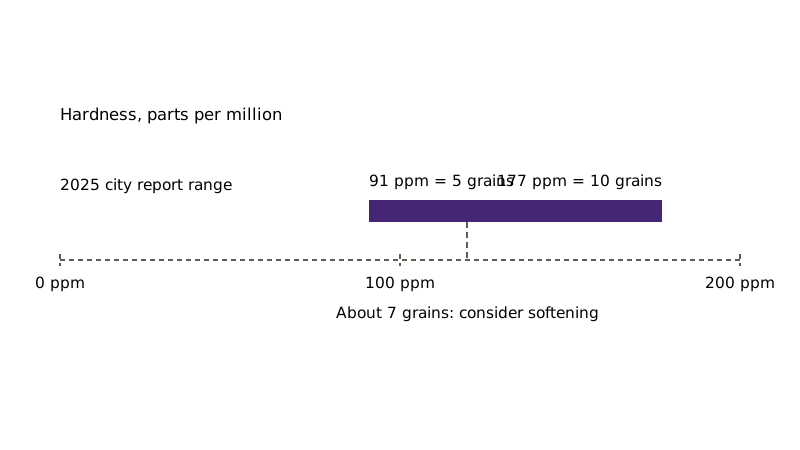
Check the utility's published report, then test your own tap. The city's 2025 report gives average hardness of 91 to 177 ppm, varying with the water source, and what reaches a particular house can differ. Softener charts speak in grains per gallon, so divide ppm by 17.1. By that arithmetic, the span is about 5 to 10 grains.
Which supplier serves you? Your bill says. Ontario Municipal Utilities Company draws on city wells, State Water Project supply and purchased groundwater, so neighboring streets may not match. Homes just across the line in Chino or Montclair may sit on other suppliers with their own reports.
A strip test kit costs little. Readings above about 7 grains are where most households start seeing film on glass and crust in the kettle. Consider that line a personal comfort level, not a rule of law, and use it only to judge whether the spend makes sense.
In what order does the installation go?
Seven moves. Close the main and drain the pipe. Tap the cold line after any outdoor spigots you'd like left hard, but before it reaches the water heater. Mount the bypass. Join the inlet and outlet to the right ports. Aim the drain hose at a standpipe with open air between hose and water. Plug in. Program hardness, add salt, sanitize.
Port direction is where people slip. IN and OUT are stamped on the head; swap them and the unit won't work. The bypass is what lets you isolate the softener for repairs without shutting down the house. Support the tank on the floor so its weight never hangs from the copper.
About that open air: it's an air gap, and it stops sewage-side water flowing backward into your drinking line. Don't force the hose tightly down the standpipe. Salt goes in last, in the form the maker lists. Start a manual regeneration and watch every joint while it cycles.
How can you clear the crust that hard water has already left?
White deposits lift with acid. Soak the part in plain vinegar for around an hour, scrub gently, rinse. On a showerhead, tie a bag of vinegar over it so you don't need tools. Avoid this on marble, travertine or fragile plated trim, and check the maker's care notes first.
Understand what a softener can't do. It prevents new crust but doesn't dig old scale out of pipe walls or from inside a heater. Fixtures stay cloudy until someone scrubs them once. When scale lives in the heater, draining and flushing the tank comes first. The longer version lives in removing hard water scale.
Another route is stopping buildup early. Habits that prevent scale are on their own page, and the whole house softener overview weighs the alternatives.
When does paying a plumber make more sense?
Pass the job along when the main is rusty galvanized steel, if nothing drains nearby, if pressure runs high, or if the layout demands new pipe. Anything needing a permit belongs here too. A single weeping joint at the main can drench a room, which makes an hour of paid labor look modest.
Check pressure first. The California Plumbing Code puts 80 psi as the upper limit, and each softener lists a maximum for its own tank. Read it with a gauge screwed to an outdoor spigot; it takes seconds. A high reading means a regulator, and the regulator adjustment guide shows how.
One more question for the city. OMUC handles wastewater collection, so a call to (909) 395-2600 is the way to ask about any limits on softener backwash. For budget numbers, read what a softener costs installed. Everything else we arrange starts at the Chaffey Pipe and Drain home page.
Common questions
What's the time commitment for a first install?
Give yourself a full day if it's your first. A practiced hand may be done in three or four hours. The time goes into shutting off water, cutting in, joining pipe, and then the wait for the first regeneration. Return to each fitting an hour after pressure is back and snug anything that weeps.
What should the installer put on paper?
See that the written scope includes the bypass, drain run, air gap, any permit and removal of an old unit. Ask why they picked the size they did, using your own water report. Learn who returns if a joint starts dripping next month. Keep the scope in writing before anyone cuts pipe.
Is it okay if nobody is home that day?
For the opening and the finish, yes. Somebody shows where the main valve sits, accepts any change in price, and sees the unit run. Expect the water off for a stretch, so schedule showers and laundry elsewhere. Clear a path to the garage or utility corner first.
Will it strip the scale already inside my pipes?
Not fast, and not fully. Fresh deposits stop forming and old ones may soften over time, though flakes can break loose. Scrub showerheads and aerators by hand, flush the heater, and treat heavily clogged pipe as a separate job if flow stays weak.
Does softened water taste or feel different?
It often feels slick on the skin, and some people notice a faint salty taste from the sodium exchange. If that bothers you, ask about a separate unsoftened cold tap in the kitchen for drinking and cooking. If your doctor limits your sodium, ask before you drink softened water.