Most homeowners pay somewhere in the $224-$800 band for a new toilet with installation, and labor is the minor share at $150-$450. Ontario prices will not match a national average exactly. What moves your number is the toilet itself, the condition of the flange under it and whether the old unit has to be hauled off. For the wider picture, see toilet repair and replacement.
What should a full toilet replacement cost?
Figure on $224-$800 for the toilet and the install together, according to 2026 national guides that cite an average close to $450. Labor makes up $150-$450 of it. The plain two-piece style is the cheapest way in, while one-piece, wall-mounted and smart toilets climb steeply.
| Toilet style | Installed, per one 2026 summary |
|---|---|
| Two-piece | $200-$950 |
| One-piece | $250-$1,400 |
| Wall-mounted | $500-$2,000 or more |
| Smart | $750-$2,500 |
| Labor only | $150-$450 |
A separate roundup puts a typical replacement at $300-$800 with a $372 average in one source, and labor at one to three hours. None of these guides prices Ontario work specifically, so use them to test a local quote rather than replace it. Moving a toilet during a remodel is a different job, covered in plumbing for a bathroom remodel.
What is the labor cost on its own?
Labor lands between $150 and $450, based on a one-to-three-hour visit. Swapping one toilet for another on a sound flange sits at the bottom. An old toilet that fights back, a rotted floor or a flange needing repair raise the hours and therefore the bill.
A handyman may quote less than a plumber for the plain swap, and a contractor license is a state requirement for work totaling $1,000, a figure this swap rarely approaches. The trade-off is scope. If the flange is cracked, the subfloor is spongy or the drain gurgles, you want a plumber on site.
Whoever you hire, find out what the number covers. The toilet, wax ring, bolts, supply line and carting away the old one can each be extra. A quote that names only labor leaves you to cover the rest.
Which extras make a toilet job cost more?
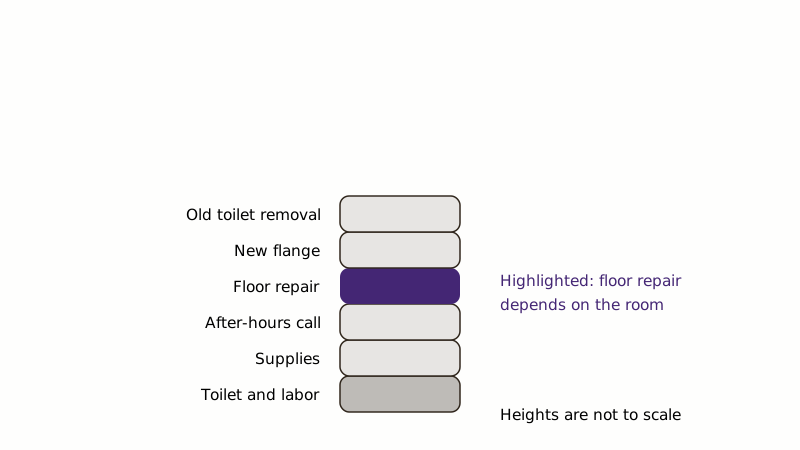
Extras are where bids diverge. Guides list old-toilet removal at $50-$200, a replacement flange at $145-$300, flooring repair at $8-$24 a square foot, installation supplies near $100, after-hours calls at an added $100-$300 and permits (where one applies) at $50-$300. The big one is moving the toilet.
| Add-on | Guide figure |
|---|---|
| Remove and dispose of old toilet | $50-$200 |
| New closet flange | $145-$300 |
| Flange repair | $60-$200 |
| Floor repair | $8-$24 per square foot |
| Relocating the toilet | $2,500-$3,500 (another guide says about $3,000 for a drain line) |
| Hidden damage found under the old toilet | up to $800 |
A swap that becomes a relocation is a different project and needs a new quote. Rot around the flange, a seal that has been leaking into the subfloor or a corroded cast iron stub are the usual discoveries, and older houses produce them more often. Think postwar tract homes in Chino and Montclair, or the older streets near downtown Ontario.
And what if the toilet only runs on and on?
Far less. A toilet that runs on usually has a perished flapper or a worn fill valve, and the EPA calls a new flapper an inexpensive, quick fix. One national guide shows general toilet repairs ranging from about $60 to $391. No official source prices this locally, so get a figure on paper first.
Test before you pay anyone. Squeeze dye into the tank and return after a short wait: color in the bowl gives away a flapper that is not sealing. EPA advice is to swap flappers every five years or sooner. DIY guides cover the causes of a running toilet, fill valve replacement and flapper repair.
Once repairs pile up, replacement may be the cheaper road, and the water bill helps. The EPA says a WaterSense swap for an old, inefficient toilet can reduce that fixture's water use by 20-60%, which the agency values at over $170 a year.
Can you buy just a new cistern, and what does that run?
The cistern is the upper half of a two-piece toilet. None of the guides price a standalone tank, and tanks are matched to their bowls, so a lone replacement can be hard to source. Parts kits for leaks cost far less, and that is what most tank complaints need.
Look at what is actually wrong. Drips at the tank-to-bowl bolts usually need a gasket and bolt set, not a new tank. A cracked tank is different: a whole toilet is usually the practical fix. Ask whoever visits to price both options, and keep the toilet's brand and model handy because many parts depend on them.
What does the replacement job involve from start to finish?
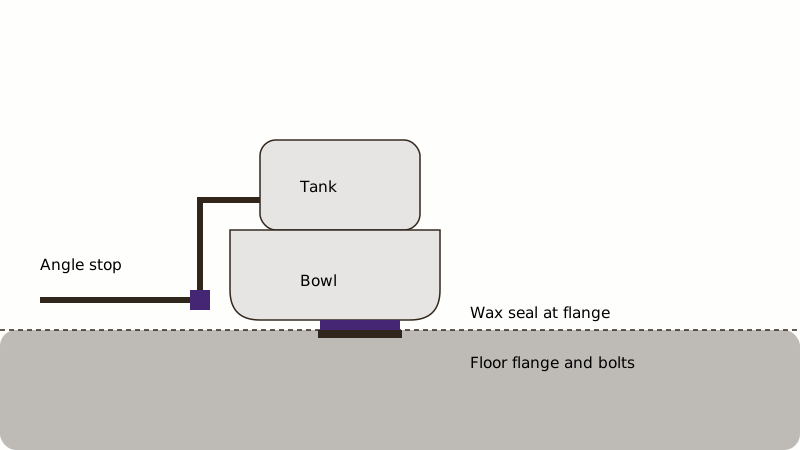
Roughly in order: close the angle stop, flush out the tank, unhook the supply, free the floor nuts, lift the old unit out and scrape off the wax. Then press a fresh wax ring into place, drop the bowl onto the flange bolts, tighten evenly, set the tank, reconnect and test for seepage.
Inspect the flange first. One that is cracked, corroded or sunk below the finished floor leaves a new toilet rocking and weeping however well it is bolted. Alternate between the nuts and stop when snug; porcelain cracks under force.
Changing only a side-mount handle? The nut inside the tank typically has a left-hand thread; clockwise is the loosening direction. Read the toilet's own parts sheet before forcing anything.
Call a plumber if the toilet will not release, the floor flexes or the drain backs up. Chaffey Pipe and Drain lines up a visit and price through its quote page. Broader rates are on what plumbers cost in Ontario, and clog work is priced under unclogging a toilet.
Common questions
Does it take a full day?
Cost roundups say a clean swap takes one to three hours. A broken flange, soft floor or reluctant old fixture adds time. Ask for a window rather than a single arrival moment, and confirm the visit includes removing the old toilet so it does not end up sitting in your garage.
What should a toilet quote spell out?
Does the figure include the toilet, wax ring, bolts, supply line and disposal? Who handles a damaged flange or floor, and at what price? List the toilet's model on the quote so offers compare fairly. Also ask whether the visit needs a permit, since some jobs do.
Does buying the toilet myself lower the bill?
It can. Paying labor only works when you choose the toilet, but then a cracked or ill-fitting one is your problem to return. Measure the rough-in (wall to flange bolts) before shopping, because a mismatch sends you back to the store.
Is it a problem if nobody is home?
It is better to have an adult there to show the bathroom and the shutoff and to approve any surprise under the old toilet. The room is out of service for a few hours. Clear the floor, roll up rugs and keep pets elsewhere until the plumber leaves.
Does an efficient toilet really cut my water use?
Usually. The WaterSense label caps each flush at 1.28 gallons, around a fifth under the older federal 1.6 standard, and some ancient models use up to 6. A toilet like that is a reasonable place to put money, and the saving appears in each water bill.