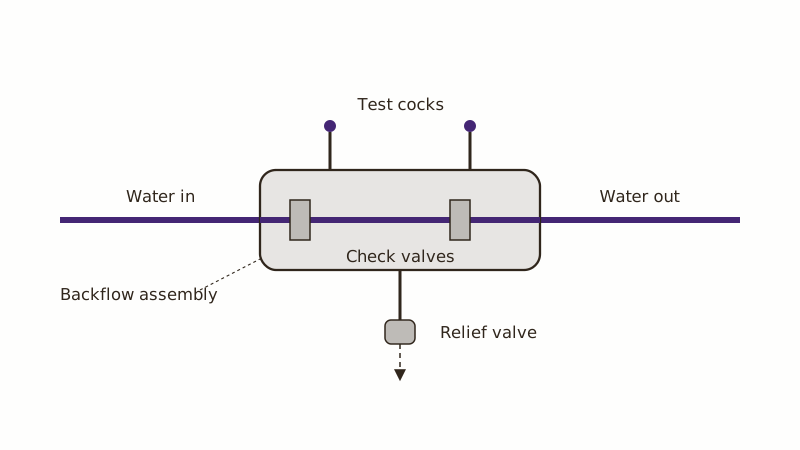
Water is meant to travel one direction, from the street main toward your taps. A pressure drop in the main, or pressure building on your side, can push it the other way and pull whatever sits at the end of your plumbing back into the public supply: lawn chemicals at a sprinkler head, a hose in a bucket, boiler water. A backflow assembly is a one-way gate built to stop that. This page, filed under permits, codes and inspections, covers what testing proves and what the owner has to do.
What exactly does backflow prevention testing check?
It checks that the assembly's internal check valves close tightly and that its relief valve opens when pressure behaves badly. A tester measures pressure differences across each part with calibrated gauges. If the parts hold, the device is doing its job. If one leaks or sticks, the device fails and has to be repaired and tested again.
Ontario treats this as a public-health matter, since a failing device can let contaminated water into shared pipes. Per a testing company's summary of local rules, protection may be required where the utility sees a cross-connection risk, with an annual test by an approved tester. We could not confirm this on an official page. Check the details with the Ontario Municipal Utilities Company at (909) 395-2600.
Is backflow testing part of a mobile home plumbing inspection?
Not as a rule. A mobile home plumbing inspection looks at supply lines, drains, shutoffs, the water heater, venting and gas connections, and any visible leaks. Backflow assemblies are tested under the utility's program, separate from a home inspection. A park or property with an irrigation or fire line has devices on the utility's schedule.
Park homes have their own pipe materials and routing, often under the floor, so ask the inspector what is included and whether they check the shutoffs and pressure. What a visit covers is spelled out in mobile home plumbing inspection. If a permit is needed for repairs, the City of Ontario Building office, (909) 395-2023, can say what applies.
For a repair or replacement, ask for quotes; the figure reaches you in writing before work. Other jobs are on the home page.
What happens to the owner when a device fails?
A fail means the device is not protecting the supply as designed. Common reasons are worn rubber seats, fouled check valves, a stuck relief valve or debris. Most are repaired with a rebuild kit, and a worn-out unit is replaced. After the repair the device must be tested again, and the new passing report goes to the utility.
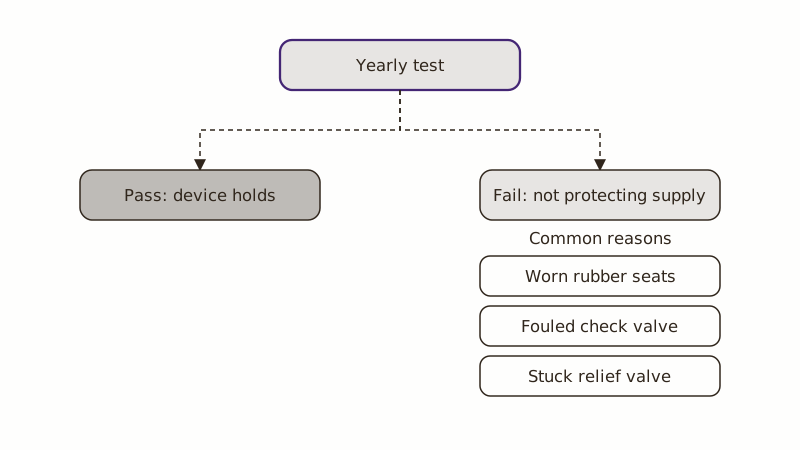
Do not delay. A bad assembly is a real contamination risk, not a paperwork issue, and the utility decides what it requires until the device passes. For an old device where repair and replacement cost about the same, request both prices. Always get a written quote before the work, and get the retest scheduled at the same time.
How often is testing required, and who handles it?
The summary calls for a test every year, with another after installation, a move or a repair. Utilities often accept reports only from testers they approve, so ask OMUC who qualifies. The property owner keeps the test records and pays for maintenance. When a plumber installs or repairs one, state rules call for a contractor holding a California license at $1,000 and up, or whenever a permit applies.
Treat the due date like a registration renewal. Notices may arrive from the utility, but do not count on them, and ask the utility what follows a missed test. Our how-to page on doing a backflow test describes the visit and the prep, and commercial backflow testing covers larger properties.
Which devices get tested?
The utility sets the kind of assembly by hazard level. The summary lists reduced pressure principle assemblies, double check assemblies and pressure vacuum breakers, among others. Higher hazards, think chemical feeds or boiler lines, call for sturdier devices. The assembly sits just after the water meter, stays accessible, and is not allowed to be submerged.
Small devices also exist on hose bibs, usually a vacuum breaker screwed onto the outdoor faucet. Utilities generally focus testing on the larger assemblies serving irrigation, fire sprinklers, pools and commercial lines, so confirm with the utility whether yours is on its list. A typical single-family house on a standard meter often has none of these to test.
Common questions
How long is the visit?
One assembly usually means a short stop: gauges on, the sequence run, readings noted. Several devices or a large one take longer, and a failure adds repair and retest time. Ask the tester for an estimate and whether the filing is handled for you.
Which questions suit a tester?
Find out if the tester holds the approval the utility accepts, whether the report is filed for you, the cost of a repair kit if the device fails, and the timing of the retest. Confirm approval with the utility at (909) 395-2600 and have the fee in writing.
Is someone needed at the property?
Usually a person has to open the way to the device and agree to a brief shutoff. A locked yard or a vault needs arranging in advance. Ask whether the test can go on without you, and be sure you receive a copy of the result.
What if I just bought the property?
Call the utility. When the property has an assembly, the owner keeps it tested, so the duty moves to the new owner and the seller may hold the last report. No notice in your mailbox is not proof nothing is due; check before the date passes.
Is DIY installation allowed?
It turns on the device and the permit rules. Assemblies that protect the public supply tie into utility requirements and often need a permit and a contractor with a license. Call the utility and the Building office before buying, because a wrong model or position can fail inspection.