Chalky faucets, cloudy glasses and a tank that rumbles under heat all suggest hardness, and a softener is the standard answer. It is also a plumbing job: the unit splices into the main supply, wants a drain for its rinse water and needs a power outlet. After a visit is booked through us, the plumber chooses the unit's size, sets it and pipes it in. Details go through the quote form, or you can phone. Other services sit under the home menu.
What do the water reports say about hardness here?
Published figures vary by supplier and source. Ontario's 2025 report lists hardness averaging 91 to 177 ppm by source. Chino's 2024 report shows city wells averaging 248 ppm, up to 280. Monte Vista Water District, serving Montclair, reports a 2025 average of 135 ppm with a high of 340. Jurupa Community Services District averages 162 ppm.
The USGS calls 121 to 180 mg/L hard and anything above 180 very hard. For grains per gallon, divide by 17.1, the conversion Monte Vista gives on its own FAQ page. So 177 ppm works out to roughly 10 grains. These are system-wide numbers, so your own tap can differ; the sample on the bill's report tells more than any map.
What goes into fitting a softener?
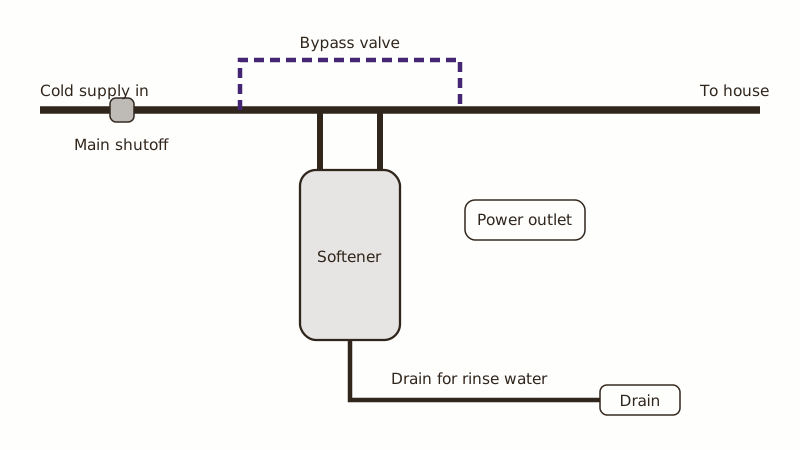
The plumber taps the cold supply after the shutoff where the main enters, ahead of the heater branch, and mounts the unit with a bypass valve so it can be isolated. Next come a drain line for rinse water, an overflow route for the brine tank, and power from a close outlet. Outdoor hose bibs are often left on unsoftened water.
Most installs leave a cold line to the kitchen or one tap unsoftened if you prefer, a choice worth raising during the visit. The plumber then sets the hardness level on the control head, starts a manual regeneration to flush air, and checks every joint for seepage. You load salt into the brine tank afterward.
Which kind of softener should I look at?
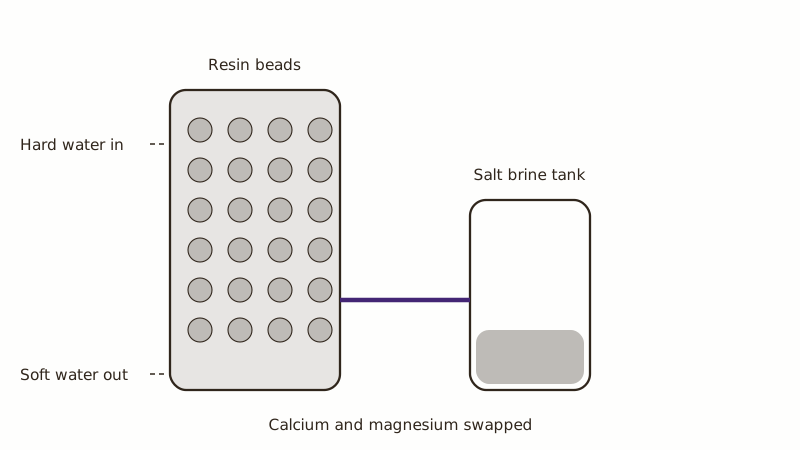
The common type is a salt-fed ion exchange tank: it swaps out calcium and magnesium, putting sodium or potassium in their place. Salt-free conditioners do not remove hardness; the makers say they change how scale forms. A small shower-head filter treats a single outlet and cannot stand in for a whole-house unit.
Brand names you see on offers include Culligan, Kinetico, Whirlpool and Aquasana. We do not push a brand. Getting the size right for your household and your water matters more than the badge. If a quote does not state the capacity and the hardness it was sized for, ask.
What moves the installation price?
Four things move the quote: the capacity of the unit, how long the pipe run is from the main to where it can sit, whether a drain and outlet already exist, and any code work such as a permit. A garage with a floor drain beside the water entry is the cheap case; a long run to a side yard is not.
We kept cost figures out of this page, because the sources we found for softeners did not separate equipment from labor. The cost guide for softener installation explains the line items to compare. For your property, the only price that means anything is the one the plumber commits to on paper.
Do I need one at all?
Crust around the spout, film on glassware, weak lather and a rumbling heater are the classic signs. According to the USGS, hard water that gets heated leaves deposits that can shorten heater life and push up heating costs, and over long periods scale can narrow pipes and cut pressure.
A test confirms it. A kit or a lab test gives a number to compare with the figures above. Read our notes on preventing scale and removing existing scale if you want to try cleaning and prevention first. A softener does not clear scale already built up inside old pipes.
Does a softener change my water bill?
Slightly, and in a way you may not expect. A softener uses water during regeneration, which adds to usage, though how much hinges on the model and its cycle schedule. We cover that in can a softener raise the bill. The softener should not be the first suspect behind a large jump.
Who should do the work, and what should I check?
Softener plumbing counts as contractor work in California. In California, licensing kicks in at $1,000 for labor and parts together, and a permit requirement brings it in at any price. Before agreeing, collect the quoting person's license number and search the board's website.
Check that the price lists a bypass valve, the drain tie-in, a first bag of salt and haul-off of any old unit. For bigger projects, read about whole-house installs or the step-by-step version. We answer phones weekdays, nine to five; the form stays open around the clock.
Common questions
Is it an all-day job?
With a drain and outlet already close by, about half a day. A longer pipe run, a fresh drain line or a cramped closet adds hours. The plumber can put a number on it after looking at the intended spot and the point where the main line enters.
Which questions suit the installer?
For a license number, the unit's capacity and the hardness it was sized against. Then the scope of the price, any permit, and the remedy if it leaks or underperforms. Also who handles servicing later. Insist on written answers ahead of any cutting.
Does someone stay in for the visit?
An adult needs to unlock the garage or utility space and agree where the unit goes. The taps go dry for a spell mid-visit, so keep laundry and showers clear of it. Cannot attend? Choose a trusted adult to stand in.
Can a softener be installed outside?
Sometimes, with protection from sun, freezing and drainage needs. Many homes here park the unit in the garage, next to where water enters. An outdoor spot needs a weatherproof setup and a compliant drain, and local rules decide what is allowed, which the plumber can look up.