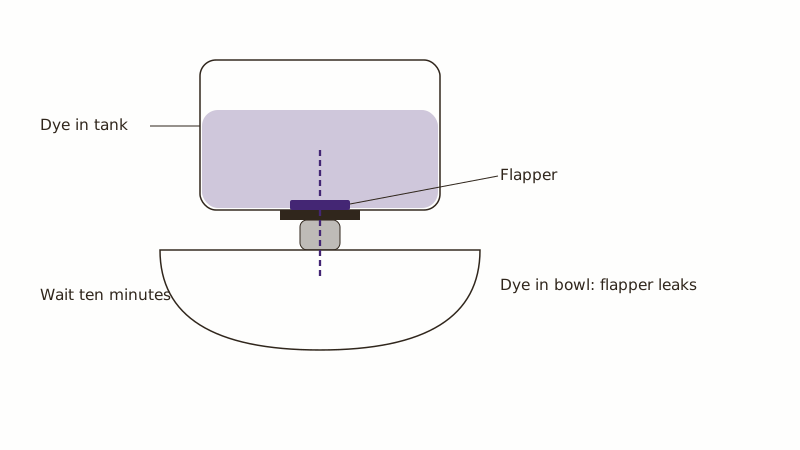
Water sneaking from tank to bowl almost always means the flapper. It is a rubber disc that rises on each flush, then falls back over the outlet to hold the tank full. Rubber hardens, warps and picks up mineral crust, and after a few years it stops sealing. Replacing it takes minutes and the part is inexpensive. If you are still tracing a running toilet, begin with toilet repair. Not keen on doing it yourself? A quote request gets a local plumber lined up.
How do you confirm the flapper is the problem?
Run the dye test from EPA's leak guidance. Color the tank water, then step away for ten minutes. Then see whether the bowl changed color. Dye that reaches the bowl means the seal has failed, at the flapper or at the seat beneath it. If the bowl stays clear, the flapper is probably fine and the fill valve or water level needs attention.
You can also feel it. Shut the supply, let the tank drain, and press the flapper with a finger. A flapper that is slick, curled at the edge or chalky is worn. Look at the seat too, the ring it sits on. A rough or crusted seat leaks even with a new flapper. For tank-level trouble, the article on fixing a running toilet covers the float.
What kind of flapper do you buy?
Match the old one. Sizes and shapes vary. The width of the outlet, where the mounting ears sit and how the chain attaches all have to line up. Bring the worn flapper to the shop, or write down the toilet's make and model (often stamped in the tank) and match from that.
Universal and adjustable flappers exist. Fluidmaster's kit, for instance, has a dial in front of the chain connection that sets flush volume: a higher number holds the flapper open longer, turning clockwise for more volume, counterclockwise for less. Where a toilet's tank shape or seat angle is unusual, a kit that includes a new drain seat is the safer choice than a flapper alone.
What does a flapper swap involve?
Start by closing the stop under the tank, then flush once and mop out the last of the water. Slip the chain off the handle arm, lift the worn flapper clear of the pegs at the bottom of the standpipe, and scrub its seat. Press the new flapper onto the pegs, hook its chain to the arm with a little slack, and let the tank refill.
Fluidmaster's instructions advise marking the tank water level with a pencil before you start, cleaning the old seat with a brush and warm soapy water, and using sandpaper or emery cloth on a brass seat. After fitting, watch a full refill. Flush several times, then test again with fresh dye. The job should leave no drips on the floor.
How slack should the chain be?
About half an inch, according to the kit's troubleshooting section. If the chain is too tight, the flapper cannot seat fully and leaks. If it is too long, the chain can get under the flapper or tangle. If the flapper closes too soon, Fluidmaster says to lengthen or shorten the chain until it stays open on its own.
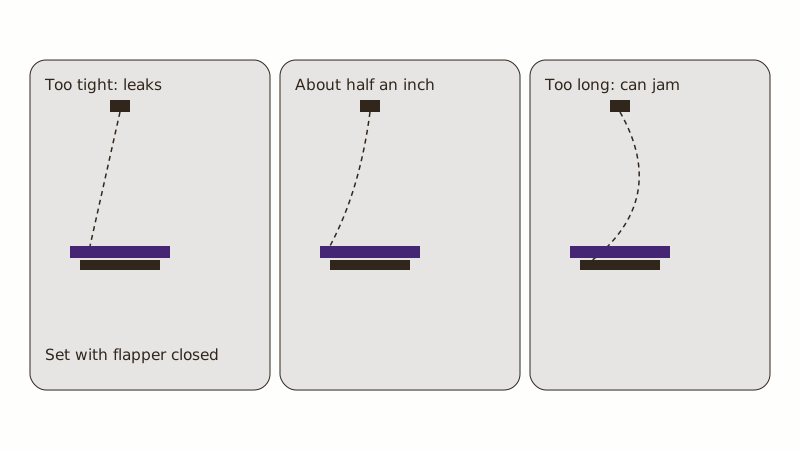
Set the chain with the flapper closed and the handle in its resting position. Trim extra links so a long tail cannot loop under the flapper. A chain clipped to the wrong hole on the lever can hold the flapper up and make the toilet run forever. Try each hole and test with a flush rather than guessing.
Why does it keep leaking after a new flapper?
Check the seat. A pitted, cracked or crusted seat will not seal a new flapper. Clean it with a scrub brush and warm soapy water, and on a brass seat use fine sandpaper. If damage is deep, a repair kit with a new drain seat that bonds over the old one fixes it, and Fluidmaster's kit includes one with a sealant ring.
Check the water level too. A code note in Fluidmaster's kit says the overflow tube top must sit at least an inch beneath the lever hole. Another cause is a flush valve that has cracked or a tank bolt leak. Still seeing dye in the bowl after every step? Time for a plumber to judge whether the flush valve needs repair or the tank assembly needs replacing.
What wears a flapper out early?
Chemicals and minerals. In-tank bleach or chlorine tablets are the most common culprit, and Fluidmaster warns that they damage tank parts and may cause flooding. Hard water leaves crust on the seat and stiffens rubber over the years. Heat and age do the rest.
Hardness in the city's 2025 water report averages 91 to 177 ppm, depending on the source, so the scale on your own parts depends on your address. Where scale is heavy, you will see white crust on the flapper and seat. Wipe the seat when you inspect it. Swapping the flapper every few years costs less than the water a slow leak wastes, and EPA's household-leak benchmark is above 9,300 gallons in a year.
Should you hire a plumber for a flapper?
Most people do not need to, but there are cases where it saves time. A plumber earns the call when the supply valve is stuck, the tank is cracked, the base leaks, no part matches, or an old brass flush valve has a damaged seat.
Chaffey Pipe and Drain arranges a local plumber for Ontario and nearby areas, with the price in writing up front. If trouble goes beyond the flapper, into the fill valve, the base assembly or the toilet itself, the actual price comes from a written quote. See replacing a toilet's flush valve and fill valve repair for the next layers.
Common questions
When does a flapper wear out?
There is no fixed interval. Rubber lasts longer in soft water without chemicals and wears faster in hard water or with in-tank bleach tablets. Look inside the tank once a year for slime, curling or crust, and run a dye test now and then to catch slow leaks.
Does a leaky flapper show up on the bill?
Yes. A seeping flapper lets the tank top itself up in small amounts all day, usually silently. EPA's benchmark for a household leak is above 9,300 gallons in a year, with toilets high on the usual-suspects list. A dye test is the quickest check.
Is it necessary to shut off the water?
Yes. Rotate the wall stop shut, flush the tank down, and mop up the remainder. Fluidmaster's instructions start the same way. Without that, the tank fills and spills while you work. A seized valve is not worth forcing, so call for help.
Why is the flush weak after the swap?
A taut chain stops the flapper from rising fully, which cuts the flush short. Flappers that come with a flush dial may also have it set low. Change one setting, test, and only then touch the next. Fluidmaster says turning the dial clockwise gives more flush volume. Adjust one setting at a time and test.
Is the flush valve a separate part from the flapper?
No. The flush valve is the whole assembly: the overflow pipe, the seat and the base. The flapper is only the rubber seal that sits on the seat. A leaking seat or a cracked flush valve needs more than a new flapper, and sometimes a plumber.