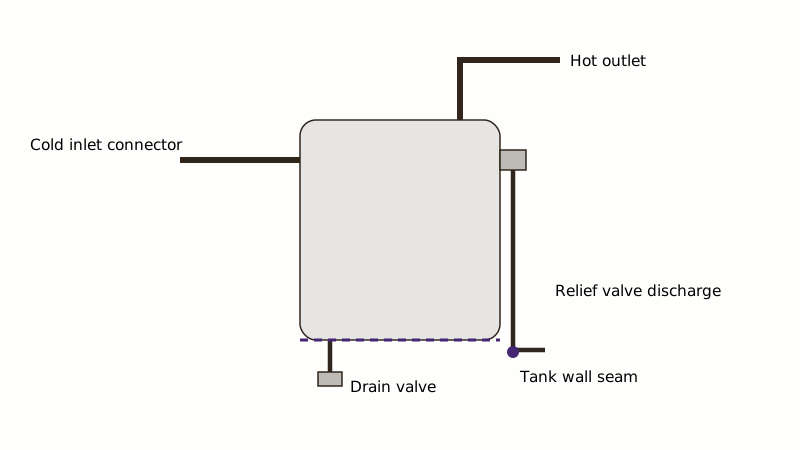
Puddle under the heater? Settle one question before anything else: is the water leaking from something bolted to the tank, or from the tank itself? Bolted-on parts can be fixed. A tank seeping through its own wall is finished. Below, a quick way to tell, plus the wider water heater repair picture. Booking help starts from the home page.
Can a leaking hot water heater be fixed?
Often yes, when the culprit is a connector, a pressure relief valve, a drain spigot or an element seal, all small jobs. Never if the shell is perforated: rust has eaten the inner wall, and a patch will not hold. That second situation means a new heater, not a repair, and it changes what the visit will cost you.
Knowing which camp you are in saves money and stress. Small parts are cheap to swap. A replacement is a real purchase, and in California cities it normally comes with a permit, so ring your city's building division, for example Ontario's at (909) 395-2023, to ask how they treat heater changeouts.
Resist guessing from the puddle. Water runs downhill along pipes and collects far from where it escaped. Towel everything dry and see which spot darkens first.
How do you pin down the source of the drip?
Dry it off, give it twenty minutes, then inspect top to bottom. Wet at the top suggests a loose supply connector. A damp discharge pipe on the side suggests the relief valve has opened. A drip near the base could be the drain valve, an element gasket or the tank itself, and only that last one is the bad news.
| Where it is wet | What it usually means | Repairable? |
|---|---|---|
| Top, around pipe connections | Loose or corroded connector | Usually; a plumber swaps it |
| The pipe that runs down the side | Relief valve opened | Often, once the reason is found |
| Low on an electric unit, behind a cover | Element gasket | Yes |
| Spout of the drain valve | Worn valve | Yes |
| Underside or bottom seam | Tank has gone | No; replacement |
| Cold pipe beaded with moisture | Condensation | Wrap the pipe |
Repeated dripping from that valve carries a message. It lets go when pressure or temperature climbs too high, so a habitual dripper can mean no expansion tank, a thermostat turned up too far, or a heater past its prime. Details live on the relief valve replacement page.
What comes first while the water is still escaping?
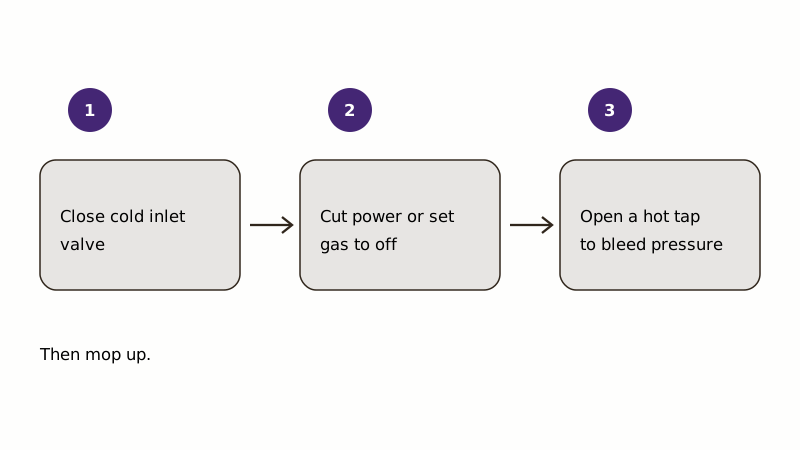
Shut the inlet valve on the cold pipe entering the heater, then take away its power. Electric units: breaker off. Gas units: dial the control to its off or pilot-off setting. A hot tap opened at a sink lets pressure bleed away. Then mop.
Standing water plus electricity is a bad mix. If the breaker panel sits in a damp area, step outside and use 911. A gas heater that leaks water while you also catch a gas smell is an evacuation: walk out, and from the sidewalk ring SoCalGas (the City of Montclair's phone list shows 1-800-427-2200 for suspected leaks).
Reasonable home steps: shutting valves, emptying a bucketful through the drain spout, nipping up a flex connector that has worked loose, drying the area to find the source. Not reasonable: cutting gas pipe, swapping a gas control, or prying the tank open to scrape sludge.
Law draws the line for you. California's contractor license rule covers permitted work and jobs of $1,000 or more, and CSLB's site lets you verify a contractor.
Is a do-it-yourself tankless install realistic?
Rarely. Tankless units draw a lot: a fatter gas line or a high-amp circuit, proper venting, often a condensate drain. Because gas fitting and permitted work fall under California's contractor license rule, the DIY portion ends well before the real job begins.
Hard water complicates matters. The Department of Energy's guide notes some manufacturers insist on a softener once hardness exceeds 8 grains per gallon (136 ppm) to 14 grains (239 ppm). Flush schedules vary from twice yearly to once every three years depending on the brand. Follow the maker's manual.
Are Rheem, Whirlpool and Bosch heaters repaired differently?
The physics are identical. What differs is where parts come from, who answers the support line and how the warranty claim works. Copy the model and serial off the plate before you ring a soul, since a plumber ordering parts will want both.
A logo is where research begins, not where it ends. Nothing here should be called trusted just because of a badge, so ask the plumber which parts they plan to fit and whether those parts carry written coverage.
Bosch shows up mostly in small electric and tankless designs. Tankless water heaters die of different causes than tanks do: scaled heat exchangers and faulty flow sensors, rather than rust through the wall.
At what point should you stop repairing and replace?
Three triggers: the shell leaks, the heater has outlived the normal range, or repair bills keep coming. Department of Energy guidance expects roughly a dozen years or more from a storage tank (10 to 15) and up to 20 from tankless. A tank near its thirteenth birthday that has just sprung a leak has told you its story.
Local water speeds things up. The USGS explains that heating hard water drops calcium carbonate scale inside equipment, which cuts life, raises running cost and weakens electric elements. Ontario's 2025 water report puts hardness at 91 to 177 ppm on average depending on source; USGS labels 121 to 180 mg/L as hard.
The rating plate carries a serial number, and most makers hide the manufacture date inside it. Then compare against our notes on replacement timing.
How much does repairing a hot water heater run, rush jobs included?
No honest figure exists without seeing the unit, so none is printed here. What holds true: swapping a part costs well below a new heater, evenings and weekends cost more than weekdays, and only the paper quote fixes your price. For new-heater ranges, see replacement cost.
Have the plumber itemize four lines: visit fee, diagnosis time, parts, labor. Itemized quotes compare fairly. A leak that will not hold until morning belongs on the emergency heater repair page. Start from the quote page or by phone during office hours.
What if the heater is dry but the shower runs cold?
Go through them in this order: breaker or pilot, thermostat dial, reset button on an electric heater, then the fuse or panel. On gas models a dead thermocouple is the classic culprit; on electric models a tripped high-limit switch is. If both check out, suspect an element, thermostat or gas valve.
Lukewarm output hints at a dead lower element or sediment piled on the tank floor. Scalding water is the opposite fault, usually a thermostat issue, so turn the dial down and have it inspected.
Relighting a pilot is described in the owner's manual. Beyond that, a gas control replacement belongs to a contractor.
Common questions
What time should you set aside?
No one can promise a time before seeing the heater. Tightening a connector or swapping a valve is brief; chasing a hidden leak takes longer; a new tank install may fill an afternoon or longer. Once the plumber has examined the unit they can estimate the time, and you agree before they begin.
Which questions belong on a checklist before a leak repair?
Collect these: the contractor license number, a quote that separates parts from labor, a line on permit costs, and the plan for hauling away the old tank. Also ask how long a new part is covered, and if you proceed, whether the trip fee comes off the total. Reluctance to write answers down tells you something.
Does somebody need to be at home?
Be there when work starts, so you can point at the heater and agree the price, and be there when it wraps up so you can check the result. Many heaters sit in garages or side closets, so explain access. Mention gate codes, dogs and cramped clearance when booking.
Can a small drip wait a few days?
A fitting drip can often wait a day if you have closed the valve and caught the water. A tank-body leak only grows, and wet electrics or gas raise the stakes. When unsure, stay conservative: inlet closed, heater off, and nothing restarted until a plumber has inspected it.