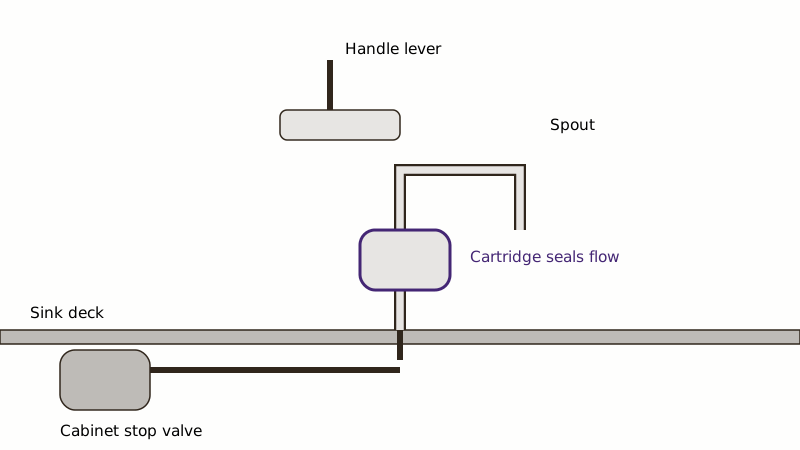
Treat a dripping faucet as a parts swap rather than a plumbing emergency. One rubber washer, O-ring or cartridge inside has stopped sealing, and replacing that piece fixes it. You need an adjustable wrench, a screwdriver, the matching part and roughly an hour. If you would rather not, sink, faucet and disposal help explains how a visit gets arranged. Faucet-by-faucet detail follows.
What wears out inside a dripping faucet?
Nothing exotic fails here. Rubber hardens, soft rings flatten, ceramic edges chip and brass seats pit. After a few years of hot and cold cycles, one of those leaves a gap the handle cannot close. The EPA counts a single drip per second as 3,000-plus gallons across a year, so a faint plink is worth silencing.
Let the wet spot point you. If the spout keeps running after the lever is off, suspect the washer, cartridge or seat. Dampness circling the handle base points to a worn seal ring or the packing. If the cabinet floor is wet, look at the braided supply hoses and their nuts before blaming the faucet at all.
Local water can hurry things along. Ontario's 2025 report shows hardness averaging 91 to 177 ppm depending on source, and limescale chews at soft seals each time the lever moves. A faucet eating a seal every year deserves a look at scale prevention.
Which style of faucet is mine?
Start by counting handles and watching their motion. Separate hot and cold handles usually hide compression stems or twin ceramic cartridges. A lone lever hides a cartridge, a ball joint or a ceramic disc. A model number near the base or in the owner's booklet settles which replacement to buy.
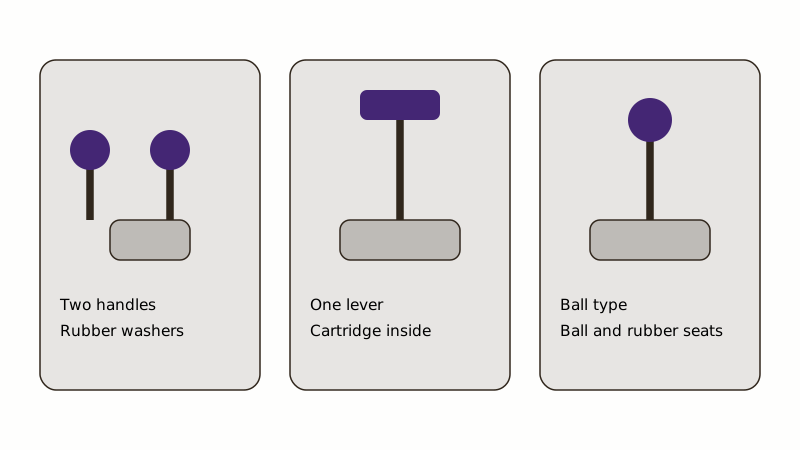
Parts are not interchangeable across makers. Delta, Moen, Kohler and Price Pfister each cut their cartridges differently, and even within one maker there can be several internal designs under the same-looking handle. Photograph the pieces as they come out and bring the worn one to the counter.
Style-specific walkthroughs live on separate pages: single-handle faucet repair and two-handle faucet repair.
How do I repair a sink faucet in the kitchen or bathroom?
Begin at the cabinet: quarter-turn each stop closed, run the faucet briefly to empty it and drop the stopper in. Pry the cap off with a taped butter knife so the finish survives, loosen the hidden screw and slide the handle free. Unscrew the big retaining nut, lift out the stem or cartridge and hold it beside the new one. Reverse the order to rebuild, opening the stops gradually.
A few small habits save grief. Park a folded towel in the basin so a tiny screw cannot escape. Snap a photo after removing each layer. Wipe a thin smear of silicone plumber grease onto new O-rings. Snug the retaining nut and stop; extra muscle cracks plastic bodies and leaves the lever stiff.
A fresh cartridge and the drip continues? Blame the seat inside the body, probably scored. A seat wrench can pull and swap that piece, but on a pitted, crusty faucet the better spend is a whole new fixture, with faucet installation cost ranges worth a look first.
Can the tub faucet be rescued with a new cartridge?
Tub faucets that dribble with the lever closed, or seep around the handle, usually want a new cartridge or stem. Stop the water to the bathroom, or to the whole house if that is your only choice. Remove the handle, remove the trim plate behind it, pull the cartridge and buy a twin. Because the valve sits in the wall, work slowly and keep every screw.
No bathroom shutoff? The main is then your only reliable valve. Stuck cartridges sometimes need a puller, and brute force can snap one deep in the wall, a good point to pause. Leaky shower faucets get a deeper walkthrough elsewhere on this site.
Water trickling from the tub spout while you shower is another defect altogether, normally the diverter, and no cartridge swap cures it.
What if the dripping faucet is outside on the house wall?
A hose bib that drips at the spout wants a new seat washer. Seepage behind the handle calls for nudging the packing nut tighter or installing fresh packing. Shut the supply first (often an indoor valve on that line), take off the handle and nut, replace the tired piece and reassemble. Whole hose bibs are inexpensive, so replacing the lot is fair too.
Plenty of outdoor faucets include a vacuum breaker, the little cap that stops hose water from creeping backward toward the kitchen taps. A burst from it while the hose runs can be normal; constant dripping with everything closed is not. A saturated wall around the spigot, or a spigot loose in the siding, hints at a leak behind the surface, so get a plumber to look before stucco or framing pays for it.
Unhook hoses between uses. A hose left attached traps water against the faucet and shortens its life.
What are the red flags that say call a plumber?
Phone a pro when a stop refuses to close, a handle or cartridge will not move after a fair attempt, water turns up in the cabinet or wall, or new parts leave the drip alive. Each of those means the fault sits deeper than a washer: a failed valve, a corroded line or a joint that needs proper tools.
Elderly shutoff valves are the classic ambush. Houses around downtown Ontario and Euclid Avenue can still have valves nobody has turned in decades, and one can crumble in your hand and convert a drip into a spray. If that happens, shut the main and make a call.
A plain drip repair is normally a short call. A state contractor license becomes mandatory when a job's labor and parts hit $1,000, a figure most faucet jobs stay below. Whoever you use, ask for a written price first.
Booking starts at the quote page of Chaffey Pipe and Drain. If a slow drip has you worried about the bill, a separate explainer covers whether leaky faucets raise water bills.
Common questions
Does a small drip really waste that much?
The EPA's figures: a drip each second means over 3,000 gallons every year, while all of a typical home's leaks combined can pass 9,300. A faucet is among the cheapest leaks to stop, with inexpensive parts and a short job, so fixing it pays quickly.
Can I swap a washer without closing the water?
No. Close the stops under the sink first, or the main if none exist, and only then loosen anything. Run the faucet afterward to bleed off pressure. A live line can soak the room and shove the cartridge out as the nut comes free.
Which replacement part fits?
Buy the one built for your faucet. Take the worn washer or cartridge to the store, or copy the model number from the body and search the manufacturer's parts diagram. Universal washer kits suit many compression stems; cartridges, in contrast, are brand specific and rarely cross over between makers.
The washer is new and water still seeps. Why?
The seat may be scored or pitted, leaving the fresh washer nothing smooth to land on. Mineral scale does the same damage. Seats can be resurfaced or replaced, though on a worn-out faucet a new fixture may cost less than the time you would spend on it.
What does a plumber do when called out for a dripping faucet?
On a visit the plumber closes the water, strips the faucet, replaces cartridge, seat, washers or O-rings, tests for drips and inspects the supply lines and stops. If the faucet is past saving, a replacement price can be given on the spot. A written quote beforehand keeps surprises out of it.