Why do plumbers dislike polybutylene?
Because it breaks down quietly. Sold widely in the United States and Canada from about 1978 to 1997, the plastic reacts with chlorine-type disinfectants in municipal water, and the fittings suffer too. Outwardly the tube looks sound; the damage is on the inside wall. Codes in this country no longer accept it for water supply.
Trouble tends to start at joints, sharp bends and stressed spots, and it arrives without notice: months of dry walls, then a sudden soaking. The lawsuit Cox v. Shell Oil closed with a reported one-billion-dollar settlement, a measure of how common the failures were.
Thinking about swapping it out? The whole-house repiping overview walks through the job from walkthrough to final test, and copper or PEX helps you pick the replacement.
Does my house have it?
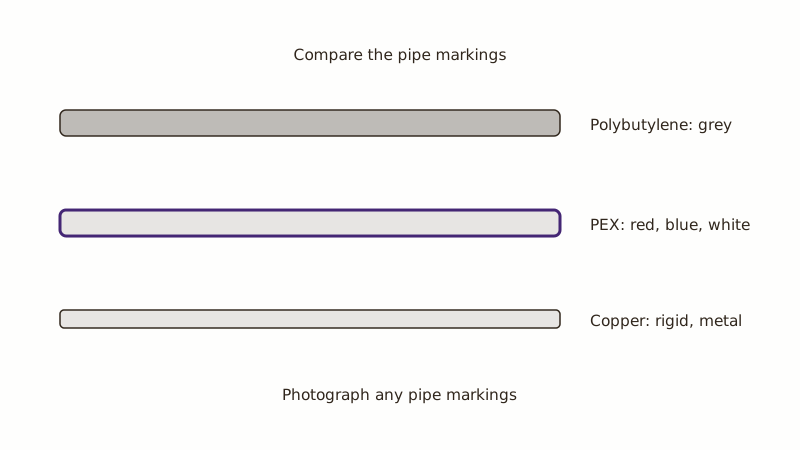
Look wherever pipe shows: beneath the kitchen sink, around the water heater, by the main valve, in the garage or the crawlspace. Polybutylene is usually gray, sometimes blue or black, bendy, and joined with plastic or crimped metal fittings. Printing on the tube, often including the letters PB, settles the question.
Beware of look-alikes. PEX is bendy too, though it usually arrives in red, blue or white. Take pictures of the markings and fittings. Printing too faint to read? A plumber can decode it. Copper, galvanized steel, CPVC and PVC are different materials with their own quirks.
Construction year is a hint, not a ruling. Anything built between the late seventies and the mid-nineties is worth a closer look. Around here that includes a lot of Chino Hills, where the city's housing element counts roughly 4,200 homes in 1980 and 16,300 in 1990, as well as tracts in Chino and Montclair. Plenty of homes from those years were plumbed in copper instead.
Replace it now, or wait for a leak?
Plenty of plumbers say now, because failures are hard to predict and one flooded wall can cost more than a planned job. Others point out that some poly-B houses never leak. What you are really weighing is risk: how old the pipe is, what a flood would do to your floors, and your comfort with waiting.
Raise the urgency if you see repeated joint leaks, stains, discolored water, a pressure drop, or a plumber who reports brittle tubing or cracked fittings. Insurance may matter too; some carriers ask about it or charge for it, so read what your own policy says. Buyers and lenders sometimes bring it up during a sale.
A finished repipe with a permit on record usually reassures a buyer. Keep the permit, inspection approval and pipe manufacturer's papers together in one folder.
What does the replacement job look like?
Fresh pipe runs to each fixture and connects at the main and the heater, then the system gets pressure tested and the walls are closed. PEX or copper is the usual material. Expect the water off during stretches of each work day, with drywall repair coming afterward, often from another trade.
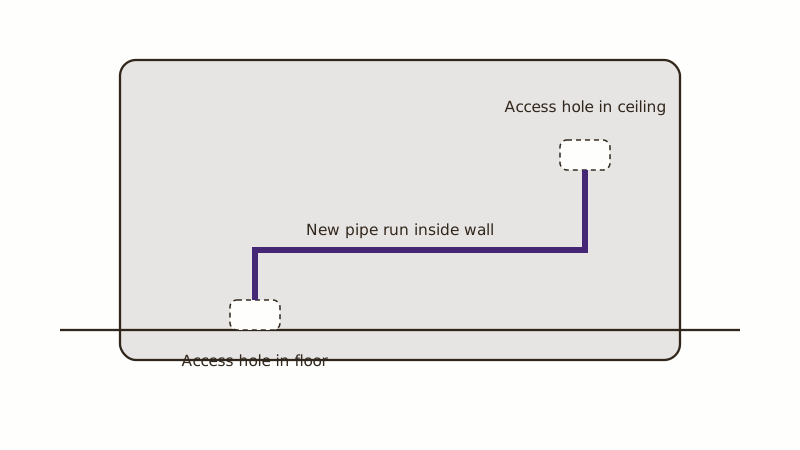
In sequence: a walk-through with a written scope; a permit if one is required; water off and lines drained; small openings cut in walls and ceilings, or runs routed through an attic or crawlspace; new pipe and fittings; a pressure test; the city inspector, if a permit exists; water back on; patching.
A popular modern layout feeds every fixture from a central manifold, so fewer joints hide inside walls. Cross-linked polyethylene comes in long coils and needs fewer connections than rigid pipe, a point the reference article on PEX makes, and it helps when walls are awkward to open. Ask each bidder how many access holes they expect, and where.
What should a polybutylene repipe cost?
It depends on the house: square footage, bathrooms, fixtures, number of stories, how easy the attic or crawlspace is to use, the material chosen, drywall repair and permit fees. A modest one-story slab house with two baths sits at the small end; a large two-story with finished walls sits at the other. Nobody can honestly name your figure without seeing it.
No dollar ranges appear here, because no source we found prices polybutylene replacement for this area, and a guessed figure would only mislead you. For the anatomy of a repipe quote, see repipe house cost and PEX repipe pricing. Gather a few itemized bids that cover identical ground: all fixtures, the heater connections, the main, permit fees and drywall repair.
Treat early numbers as ballpark. A firm price arrives on paper after someone has walked through the house.
Who handles the permit and the work itself?
A repipe normally brings a permit, and California sends permit work to a contractor holding a state license. The city building department grants the permit and dispatches an inspector. Owners can sometimes pull their own, which also makes them answerable for the outcome.
In the City of Ontario, the Building office sits at City Hall, 303 East B Street, (909) 395-2023. Chino Hills Building & Safety and the City of Chino Building Division cover their own areas; call the one for the city your house is in. Find out who files, and check the license number with the state before signing anything.
Warning signs in a bidder: pressure to sign today, a request for a large deposit, or reluctance to write the scope down. The state limits home improvement deposits.
Is a repipe also the time to deal with water quality?
Not exactly, since new pipe does not change what the utility delivers, but it is a convenient moment to plan. Ontario's 2025 report puts hardness averages between 91 and 177 ppm by source, and which supply reaches you depends on your address. Scale affects heaters and fixtures regardless of what pipe carries the water.
With walls already open, ask about a stop valve at every fixture, an easy-to-reach main shutoff, a pressure regulator if needed, and a spot to add a softener later. Good planning leaves you with better access along with new pipe.
Do not forget the water heater hookup: flexible connectors and old unions near the tank are classic weak points, and replacing them costs little while the plumber is there.
How do I arrange quotes?
Tell us the age and size of the house, bathrooms, slab or raised floor, what pipe you saw and any leaks so far. A local plumber will be sent to inspect, and phones are answered weekdays, nine to five. Our quote page is the front door; the Chaffey Pipe and Drain home page has the rest.
Ask every bidder to name the pipe they found, the material they propose, the permit plan and the wall repair, all in writing. What binds is the written quote after an in-person look, and a second bid keeps everyone honest.
Common questions
Is poly-B the same thing as PEX?
No. Polybutylene is the older plastic that fell out of use; PEX is cross-linked polyethylene, widely installed today. They can resemble each other, so read the markings. Ask a plumber to confirm what you have and why PEX escapes polybutylene's reputation.
Is polybutylene a health risk?
The main danger is water damage rather than toxicity. Leaks soak walls, floors and belongings, and mold can follow. Close the water at the first sign of trouble and get the system inspected. For questions about drinking water quality, ask your water supplier directly.
Could I just patch one leak and leave the rest?
A repair can stop a single leak, but pipe and fittings elsewhere share the same age and weakness. Many plumbers read a leak as the cue to plan a repipe. A patch can buy time; ask the plumber how much.
Will my insurer pay to swap it?
Typically not as maintenance. Policies often cover sudden damage from a leak, depending on wording, but not replacing pipe before it fails. Ask how your insurer treats polybutylene, and hang on to records of any repipe because it may matter for coverage and a future sale.
How long is the house a work site?
An average house takes several days, with water interrupted for part of each, followed by drywall, texture and paint. Size, access and inspection scheduling shift it. Request a schedule in writing, and ask how the household will keep a working toilet and running water.