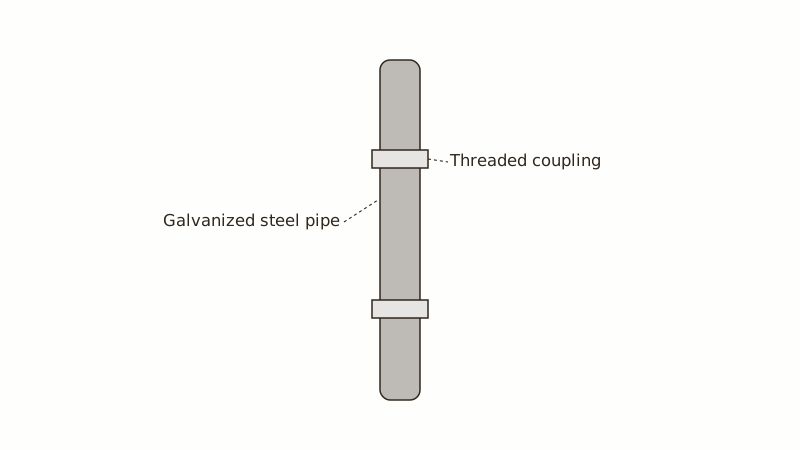
Steel pipe coated in zinc was a common choice for water lines in older homes, and the coating wears away over decades. The rust that follows narrows the pipe from within. Once that begins, one repiping guide says, "the only permanent fix is a full repipe." This page, part of our repiping section, explains how to tell if your pipes are at that stage and what replacement involves.
How can I tell if galvanized pipe is failing?
Look for weak pressure across the house, water that runs brown or orange after sitting, and leaks that keep reappearing at different spots. Gray, dull pipe with a threaded fitting at each joint is the usual look. Roto-Rooter notes that mineral buildup and rust in older galvanized pipes can narrow them and eventually cause failure.
Hard water adds to it. The USGS says scale can narrow pipes over long periods and lower pressure, and our local water reports show hardness well into the hard range. If you are unsure what is inside the walls, a plumber can look at an exposed pipe or at the connection by the meter, and a magnet or a scratch test helps tell steel from copper.
Which neighborhoods are most likely to have it?
Older homes. Around downtown Ontario and the Euclid Avenue historic corridor, and in postwar tract houses in Chino and Montclair, original plumbing is more likely than in newer communities like Ontario Ranch. Nobody can know what a given house has without looking. Records from the previous owner, an inspection report or a plumber's visual check will tell you.
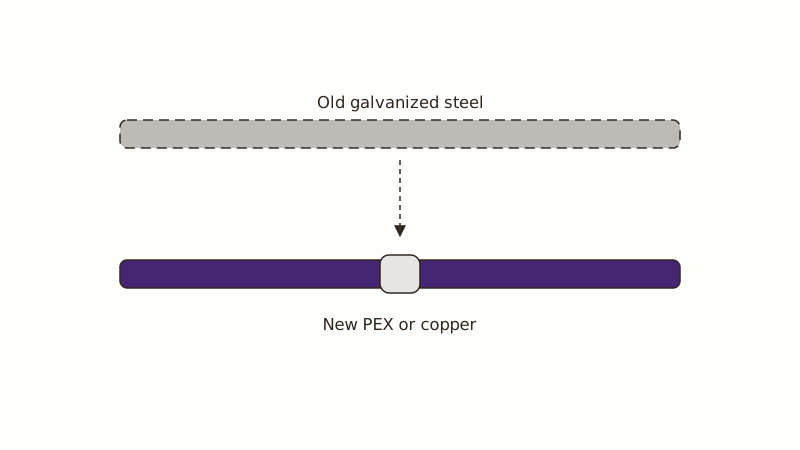
Partly repiped houses are common, with new copper or PEX spliced onto old steel. Joints where two different metals meet deserve a look, because mismatched metals can corrode at the junction. See our downtown Ontario page and Chino page for local housing notes.
What goes in where the steel comes out?
PEX or copper, in nearly every case. By the repiping guide's reckoning, PEX has a service life of four to five decades or more, copper seven to ten. PEX costs less and installs quicker. Copper outlasts it, and suits owners who prefer metal. Neither is a mistake.
Trade-offs such as fittings and water chemistry are compared on PEX versus copper. Whole-house dollar figures are set out in what an old house costs to replumb. Whoever quotes should give a reason for the material they pick.
How long will the house be disrupted?
The repiping guide says two to five days for a standard home. Small and open, it can be done in roughly two; large, with pipes inside finished walls, it can eat most of a week. The taps go dry for chunks of each day, and wall patching follows.
Work happens in stages: new lines from the main, then fixtures a group at a time, a pressure test, and last of all the old pipe is cut out or left capped in the wall. Ask how a toilet and one cold tap will stay usable overnight. A fuller walk-through is under the repiping walk-through.
Is a permit needed?
Generally, yes. The guide lists a plumbing permit for a whole-house repipe at $100 up to $400, depending on the city, with the inspector normally visiting before the drywall goes back. California's contractor license rule applies too. Ask who applies and when the inspector is due.
The permit office depends on the address. Ontario's Building counter answers on (909) 395-2023, and the City of Chino's Building Division on 909-334-3251. A discount that depends on skipping the permit invites problems at resale or with an insurer, so decline it.
Is there a replacement program for polybutylene?
None that we could confirm today, so check with a plumber and your insurer before assuming one exists. Polybutylene, a gray plastic pipe, went into some houses long ago. The repiping guide advises a full repipe, because failures cannot be predicted and a partial job leaves the system exposed.
Polybutylene pipe replacement covers recognizing it and what removal involves. Look for a printed marking on the pipe, often visible by the water heater or at the meter.
What do I settle before saying yes?
First, the quoting person's license number, searchable on the state contractor board's site. The threshold for needing one is $1,000 in combined labor and materials, and it applies to permit jobs of any size. Then pin down the material quoted, the fixtures included, who patches walls and what a failed inspection means.
Compare two written quotes for one scope. State law limits home improvement deposits, so a large payment in advance is a warning sign. What matters is whatever a plumber writes after seeing the house, and asking for one is the way in. National ranges are in the repipe cost guide.
Browse other jobs from the site's front page.
Common questions
Can the pipe be cleaned out?
Not really. Once rust has narrowed steel pipe there is little that restores it, and the repiping guide says a full repipe is the permanent fix after corrosion restricts flow. A plumber can tell whether trouble is confined to one section, in which case a partial job might do.
How long can I put it off?
No set date applies. Pipes fail gradually, so watch for pressure drops, discolored water and repeated leaks. A remodel that already has the walls open is a cheap moment to replace the lines in that area. A plumber can advise on timing.
Will my water taste or look different after the repipe?
Discoloration from old steel pipe usually clears once the old lines are gone. Water may look cloudy for a short time after the new pipes are filled, from trapped air. Run taps for a few minutes. Hardness stays the same, since that comes from the source water, not the pipes.
Must I stay in while they work?
For the first day at least, to approve fixture locations and give access. Cabinets and closets near the work need clearing. If you cannot attend, a trusted adult may let the plumber in once the price has been agreed on paper.