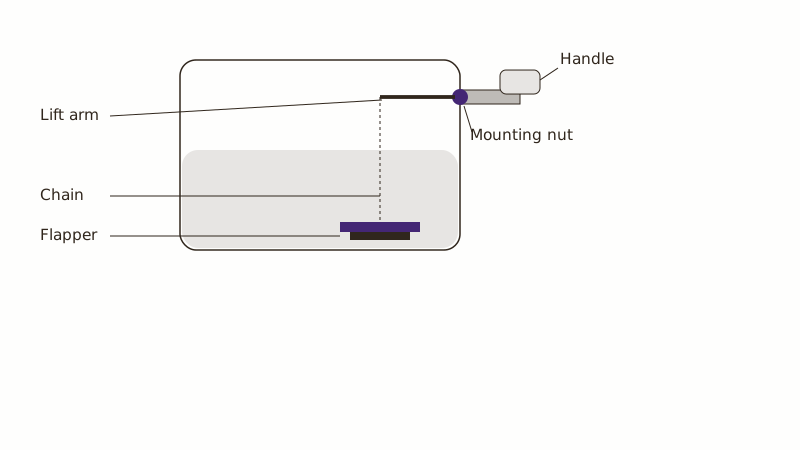
Lift the tank lid, lean in, and work the handle while you watch the parts move. If the arm moves but the chain does not lift, the chain has come loose or the handle is detached. If the arm barely moves, the mounting nut is loose or stripped. That is the whole diagnosis. The rest of the toilet family of problems is gathered in the guide to toilet repair.
None of this needs special tools, and the parts are cheap. What matters is knowing which direction the handle nut turns, and not dropping the heavy ceramic lid.
What is happening inside the tank when the handle goes slack?
A toilet handle is a lever. Pushing it raises an arm inside the tank, which pulls a chain, which lifts the flapper off the drain opening so water can rush into the bowl. If any link fails, the flush does nothing. When the handle feels slack, the fastening nut on the tank wall has typically backed off, or the arm has bent or come away.
Three failures are common. The nut loosens until the handle spins freely. The lift arm cracks or bends, so the motion no longer reaches the chain. Or the chain slips off the arm or the flapper and hangs slack. The tank also affects the answer: a tank that is not refilling means the problem is not the handle at all.
How is a wobbly handle snugged up again?
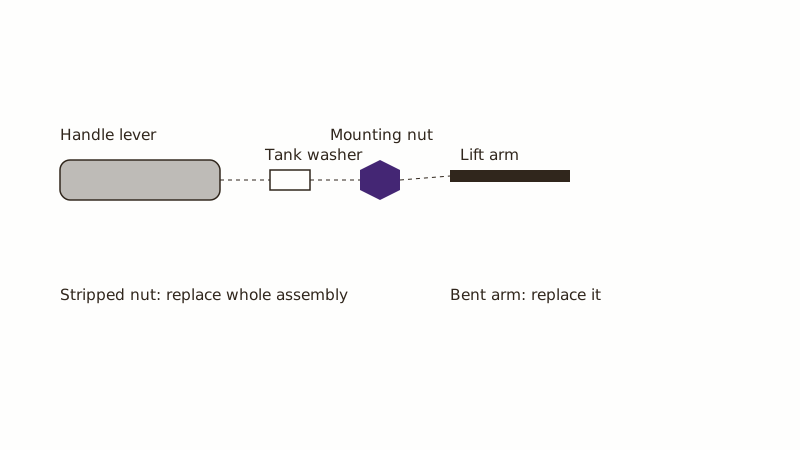
Reach inside the tank, hold the handle's arm, and tighten the mounting nut that sits behind the tank wall. Most of these nuts have left-handed threads, which means counterclockwise snugs it up, and the opposite direction frees it. Read the manufacturer's sheet if it resists. Snug it by hand or with pliers, without cranking, since porcelain cracks.
If the nut spins without tightening, its plastic threads are stripped and the whole handle assembly needs replacing, which is an inexpensive part available at any hardware store. Close the wall valve and flush the tank dry. Take out the worn assembly and install a matching one. The lid is heavy porcelain, so rest it on a folded towel at floor level; the seat is a poor place for it.
Why will the toilet not flush even though the handle moves?
Check the chain. Too much slack, and the flapper never lifts; too little, and the flapper cannot close and the toilet runs. The usual target is a little slack, roughly a half inch, with the flapper seated. If the chain is attached to the wrong hole on the arm, move it. If the flapper is deformed or stuck, replace it.
Another cause is the water level. A tank that is nearly empty has too little water to push a flush, and that points to a fill valve or a closed supply valve. Compare the water level with the overflow tube; it belongs a bit under the tube's rim. A full tank with no flush suggests the chain is fine and the obstruction is in the trap. A bowl that rises when flushed is a blockage, which the clogged toilet guide covers. For the flapper itself, toilet flapper repair shows how to match and fit a new one.
When does the handle itself need replacing?
Replace it when the lever is bent or cracked, the nut keeps stripping, the finish is corroded and sticks, or the arm no longer reaches the chain. A new handle kit is a small part. Pick a front-mount, side-mount or angled kit that matches your tank and brings the arm the same distance as before.
Hard water makes metal handles corrode and stick faster. Scale accumulates locally, since the 2025 report for the city puts average hardness at 91 to 177 ppm depending on the source, and tanks here often show scale or mineral crust on the chain and flapper. Older homes near downtown Ontario and the Euclid Avenue historic district may have older tank styles where parts are harder to match, so take the old handle to the store. If the flush is weak even with a working handle, toilet flush repair covers rim holes and flush valves, while one that keeps running afterward is dealt with in stopping a running toilet.
Could this be more than a handle problem?
If the tank leaks, the bowl cracks, the flush valve is worn, or the supply line drips, the repair moves past a handle swap. Certain flush valves can be replaced without lifting the tank, as swapping a flush valve explains, and a leaking tank may justify a new toilet.
A toilet that leaks wastes water continuously: toilets are a frequent source of household leakage, which the EPA puts above 9,300 gallons a year. See a toilet that leaks to track down where water is escaping, and what replacing a toilet costs for the budget side. You can book a plumber on the quote form. Browse the home page for other things we arrange.
Common questions
How quick is this repair?
Tightening a nut or re-hooking a chain takes five to ten minutes. Replacing a handle kit takes about fifteen to thirty minutes including draining the tank. A stuck or cracked flapper adds a little more time. If you hire help, a plumber usually completes it in one short visit.
What do I clarify with a plumber beforehand?
Whether the quote covers parts and a check of the flapper, fill valve and water level, not only the handle. Whether the toilet is worth repairing at all. Request a written price before anyone arrives. California applies contractor license rules to permit work and to any job from $1,000.
Must someone be present?
A do-it-yourself fix happens with you there anyway. When a plumber visits, an adult should indicate the toilet in question and try the flush at the end. Keep the floor around it clear, and mention it if more than one bathroom has trouble.