Run the cold tap next to it, then try the hot tap in another room. One dry hot tap points at that faucet or its own supply line. No hot flow anywhere, with normal cold, points toward the heater and the valves surrounding it. The cases are sorted below, as part of the faucet and disposal repair cluster.
Why is hot water not coming out of one faucet but cold is fine?
Usual suspects: a clogged aerator, a worn or jammed cartridge, a half-closed stop valve beneath the sink, or a kinked hose on the hot side. Because the rest of the house still gets hot water, the trouble is confined to this fixture. Start with the cheapest item, the mesh screen in the spout.
Work in this order:
- Twist off the aerator and look for grit or white crust
- Confirm the hot stop valve below the basin, normally the left one, is fully open
- Inspect the braided hose for a bend or a flattened stretch
- On a single-handle faucet, suspect the cartridge, which a plumber or a matching part will cure
Mineral deposits are plausible here. Ontario's report for 2025 gives hardness averages between 91 and 177 ppm by source, and scale builds up inside aerators and cartridges over time. Leave the aerator in a cup of vinegar for an hour. Household descaling is covered in dissolving mineral crust.
What if no hot water runs anywhere in the house?
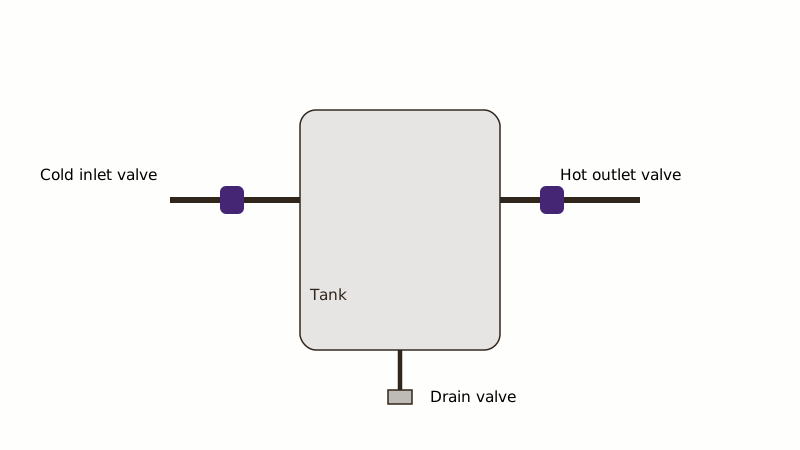
Then hot water itself has stopped arriving, and the heater becomes the prime suspect. Look for power or gas, a thermostat that is set, and a cold inlet valve that is open upstream of the tank. If you have just had work done, a valve left closed is the commonest cause of a dry hot side.
On a gas tank, see if the pilot burns or the display flashes a code. On an electric one, find the breaker and reset it a single time if it tripped. With a tankless unit, check the panel for a code. A heater that runs yet delivers nothing may sit behind a closed valve. Narrower pages exist for a lit pilot with no heat, electric tanks that go cold and tankless units that stop.
A gas odor near the heater means no relighting anything. Step outside and phone SoCalGas, 1-800-427-2200, listed among the City of Montclair's phone numbers, or dial 911 if the danger is obvious.
Could a valve be the whole problem?
Quite possibly, which is the least costly cure. Homes have valves at the heater's inlet and outlet, at the main, and under each fixture. After any plumbing work, a heater flush or a leak test, a valve can be left shut or cracked open only slightly. A valve open a sliver delivers a trickle that looks like low pressure.
With a lever valve, open means the handle lines up along the pipe. On a gate valve, the wheel is turned fully counter-clockwise and then eased back slightly. Never force a stiff valve; old ones snap. If a valve will not move, or drips when touched, a plumber should replace it. The partial-flow version of the problem is dealt with in weak hot water pressure.
Why do I get a trickle of hot water, or only warm?
A trickle generally traces to a partly blocked line, a valve not fully open, a screened fixture clogged with grit, or, in older houses, galvanized pipe narrowed by rust. Lukewarm water is a heater problem: a failed element, a failing thermostat, a heavy layer of sediment, or a tank sized too small for the demand.
Sediment collects on the tank floor, quicker in hard water. It insulates the burner or elements and reduces the heat reaching the water. Draining and flushing is a maintenance task covered in manuals, but a plumber should handle a heater with a leaking or stuck drain valve. On an old tank, replacing may beat repairing, and swapping out the tank explains how to decide.
Is the problem on the pipes, not the heater?
Sometimes. Old galvanized steel in older homes near downtown Ontario and the Euclid Avenue corridor can scale up and restrict flow, and hot lines, which heat and cool all day, tend to clog first. A broken pipe or a failed fitting on the hot side can drop flow too. A damp wall or ceiling stain is the warning sign.
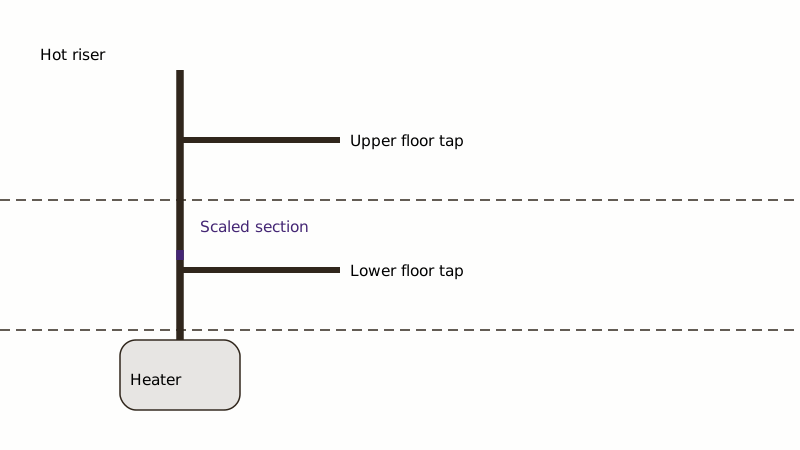
When every hot tap runs weak but cold is fine, a plumber can test pressure on both sides and look for a restriction at the heater connections. If pressure everywhere is high, the code's section 608.2 sets 80 psi as the static ceiling, and a regulator can bring a higher reading down. In newer homes, plastic pipe is common, and fittings and valves, not scale, are the likelier trouble.
Is anything here dangerous while I troubleshoot?
Yes, mostly, but be cautious with the heater. A tank with an unusual hiss, a hot pipe that is too hot to touch, a gas smell or water pooling beneath it should be shut off. Never run a tank with its water supply closed, because pressure builds. And when hot water returns after an outage, test it before a child's bath, since it can come back scalding.
If the thermostat has been turned high to chase more hot water, set it back after testing. A tank that steams or rumbles without delivering hot water calls for a prompt plumber visit, not experiments. What counts as urgent is listed under urgent heater repair.
What should I tell a plumber?
Describe which fixtures lack hot water, whether cold is normal, the heater type and age, any pilot, breaker or error code, and recent repairs or shutoffs. Pictures of the heater label and the valves help the first visit. The quote form takes those details, and the front page at Chaffey Pipe and Drain lists the related services.
Common questions
Which quick checks take under ten minutes?
Compare hot and cold at two faucets, then glance at the heater: power or gas on, thermostat set, cold inlet valve open. Those steps catch most cases. A normal-looking heater with one failing faucet sends you to the aerator. Gas odor means leave first.
Will hot water return by itself?
Sometimes, if the cause was a tripped breaker, an air pocket after work on the pipes or a utility outage. If it does not return within a normal heating time, something is wrong. Repeated outages, a heater that cycles off, or a dry hot tap that keeps coming back need a plumber, not another reset.
Could my hot water pipe be frozen?
It is unlikely here, since hard freezes are rare around Ontario, though an exposed outdoor or attic line can freeze on an unusual cold night. A frozen pipe often has frost or a bulge on the surface. If you suspect one, open the faucet, warm the pipe gently with a hair dryer, and never use an open flame.
Must someone be in the house for the visit?
Yes: open the door, point out the faucets and heater and say what changed lately. A single faucet needs little more than that. If the heater has to be drained or replaced, someone must approve the work and stay reachable, since water and gas or power may be off.